
Introduction: The AI Buzzword Carousel
If you’ve been following artificial intelligence over the past two years, you’ve probably noticed that the industry has a remarkable talent for inventing new terminology. Just as everyone became comfortable with Prompt Engineering, along came Chain of Thought. Before long, people were debating Retrieval Augmented Generation, Agentic AI, and more recently, Tokenmaxxing. If your AI glossary is beginning to resemble a dictionary, don’t worry—you are not alone.
Now, there is another concept beginning to gain attention: Loop Engineering. Unlike some buzzwords that disappear faster than last week’s framework, this one reflects a genuine shift in how AI systems are being built.
Before Loop Engineering
The journey here has been interesting. Prompt Engineering taught us how to ask AI better questions. A carefully crafted prompt often produced dramatically better results than a vague one. Chain of Thought encouraged models to reason through problems one step at a time rather than jumping directly to an answer. Retrieval Augmented Generation, or RAG, connected language models to external knowledge so they could answer questions using current and domain specific information. More recently, Tokenmaxxing encouraged employees to use AI aggressively, maximizing token consumption in pursuit of faster learning and greater productivity. Each of these concepts improved AI performance in its own way. But they all largely assumed something important:
The model gets one shot at the problem.
Loop engineering questions that assumption.
What Is Loop Engineering?
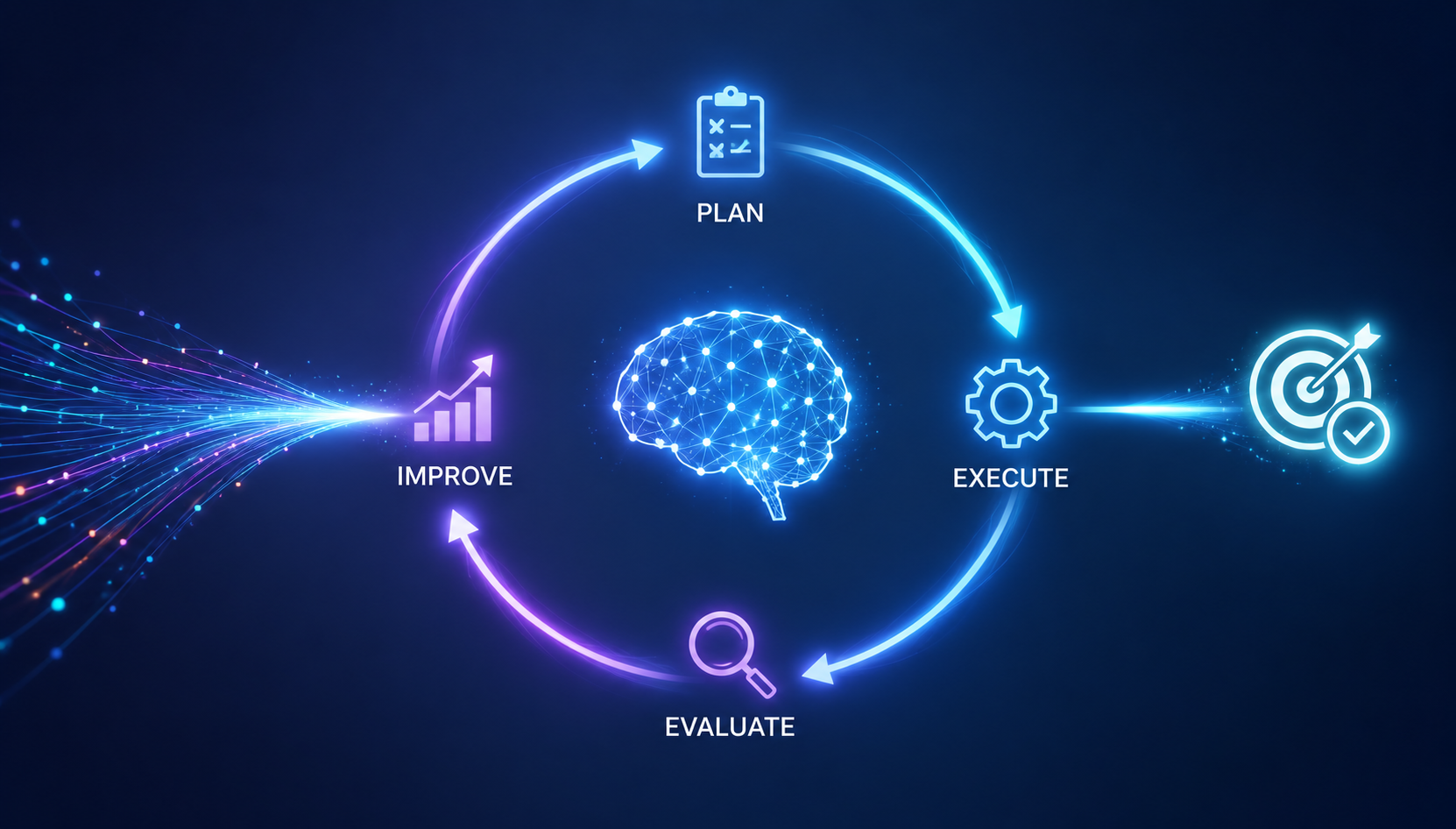
Loop Engineering is the practice of designing AI systems that continuously improve their own output through structured feedback loops. Instead of asking a model one question and accepting its first answer, the AI follows a cycle:
Plan.
Execute.
Evaluate.
Improve.
Repeat.
Rather than behaving like a student taking a one hour exam, the model behaves more like an engineer who builds something, tests it, discovers flaws, fixes them, and tests again. That simple difference changes everything.
Why Did Loop Engineering Emerge?
Large language models are impressive, but they remain imperfect. They occasionally hallucinate. They misunderstand instructions. They overlook details. They confidently explain things that never happened.
As organizations began deploying AI for increasingly important business tasks, relying on a single response became risky. Developers therefore started building systems that allow one AI step to critique another. Sometimes the same model reviews its previous work. Sometimes multiple specialized agents review each other’s outputs. The result is an iterative workflow that more closely resembles how humans solve complex problems.
Ironically, after spending years trying to make AI behave like humans, we have now discovered that AI also benefits from sleeping on it—except instead of sleeping, it runs another loop.
How Loop Engineering Works
A typical Loop Engineering workflow consists of several stages. The AI first creates a plan for solving the task. It then executes the plan. Next, another evaluation step measures the quality of the output. The evaluation may look for:
- factual accuracy
- completeness
- logical consistency
- policy compliance
- formatting quality
If problems are identified, the system generates a revised solution. The process repeats until either the objective is achieved or a predefined stopping point is reached. In many ways, Loop Engineering brings software engineering discipline into generative AI.
Why It Matters
The biggest advantage of Loop Engineering is reliability. Instead of assuming the first answer is correct, the system actively questions itself. This leads to:
- higher quality outputs
- fewer hallucinations
- greater consistency
- improved reasoning
- better enterprise readiness
For businesses, this is particularly valuable. A chatbot answering trivia questions can afford occasional mistakes. An AI reviewing legal contracts, processing insurance claims, or approving financial transactions cannot. Loop Engineering helps bridge that gap.
The Limitations
Of course, nothing comes for free. Every additional loop consumes more compute, more time, and here it is – more tokens. A task that once required one model invocation may now require five or ten. This increases infrastructure costs and latency.
There is also the possibility of diminishing returns. Beyond a certain point, additional loops may simply produce slightly different answers rather than significantly better ones. In other words, asking an AI to rewrite its answer twenty times may eventually resemble asking five committee members to edit the same presentation.
The slides become longer.
The message becomes shorter.
Looking Ahead
Loop Engineering represents a natural evolution in artificial intelligence. Prompt Engineering taught us how to ask better questions. Chain of Thought taught AI to think more carefully. Loop Engineering teaches AI something humans have known for centuries:
Your first draft is rarely your best draft.
As AI systems become more autonomous, designing effective feedback loops will likely become as important as designing good prompts. The future may belong not to the model that answers first, but to the one that knows when to ask itself, “Can I do better?”