
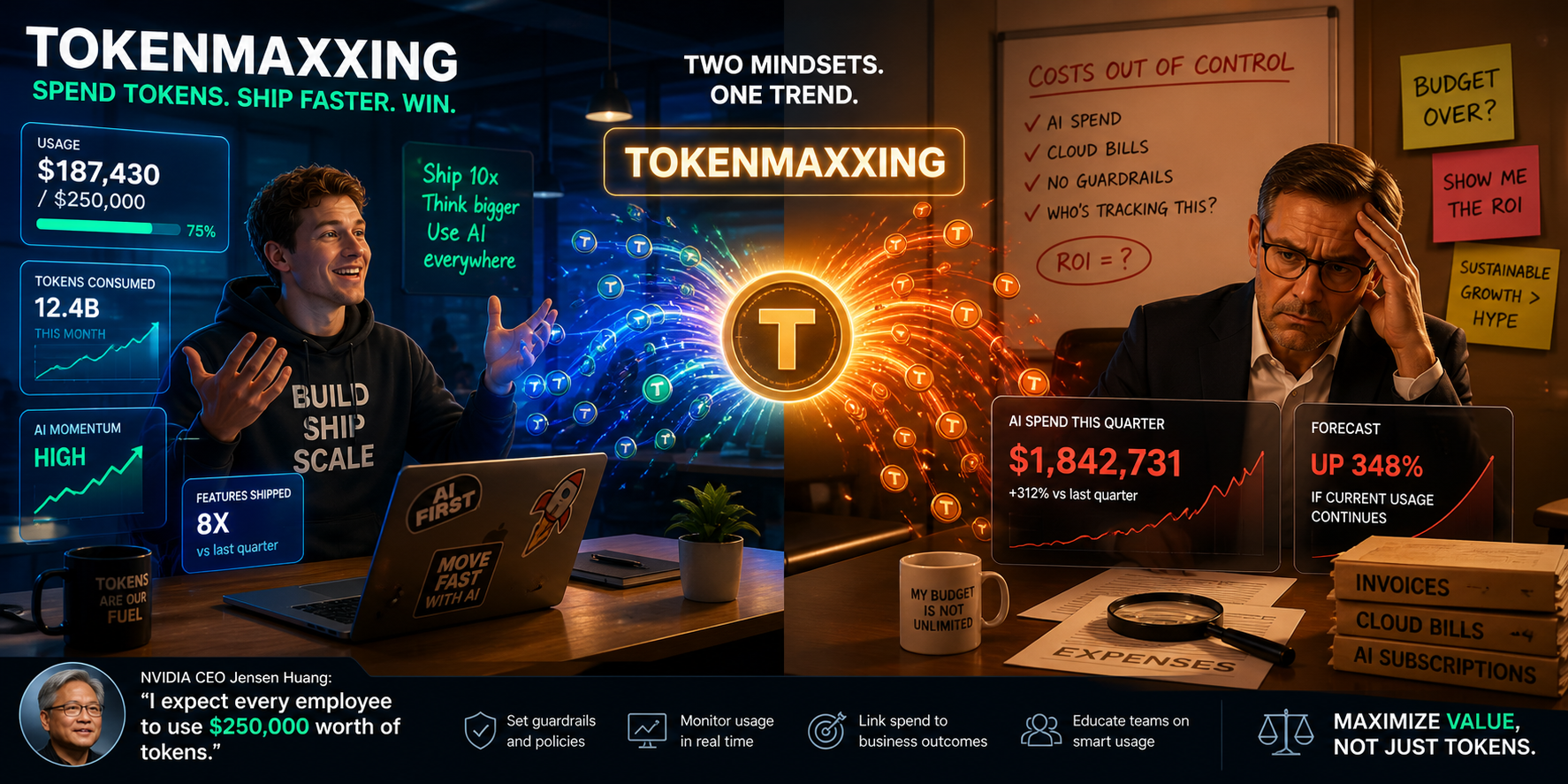
Tokenmaxxing is the latest buzzword making rounds in AI driven companies. At its core, it is simple: encourage, even expect, employees to maximize their use of AI tokens. The idea is that more usage leads to more experimentation, more learning, and ultimately more innovation. In a world where AI capabilities are evolving daily, the logic feels compelling. If tokens are the fuel, then why not step on the accelerator?
We are hearing about tokenmaxxing now because companies are racing to embed AI into every workflow. Leadership teams want velocity. They want employees thinking “AI first” for every task, from coding to research to customer support. There is also a strong signal from the top of the industry. Jensen Huang famously set the tone by expecting employees to use up to $250,000 worth of tokens, reinforcing the idea that AI usage is not just encouraged, it is expected.
This mirrors an earlier playbook. Public cloud vendors once handed out generous credits to startups to drive adoption. Today, AI platforms are doing the same with tokens. The goal is clear: get teams hooked on the capabilities, integrate AI deeply into operations, and worry about the bill later. From a startup executive perspective, this makes perfect sense. Speed matters more than precision. If tokens help ship features faster, unlock insights, and compress timelines, then the spend feels like an investment, not a cost. In this mindset, tokens are not expenses, they are growth multipliers.
Now let’s switch lenses.
From a CFO’s chair, tokenmaxxing sounds less like innovation and more like a budgetary suspense thriller. Encouraging unlimited or loosely governed usage is eerily similar to how cloud costs spiraled out of control in the past. It starts innocently. A few experiments here, a few models there, some instances left running over a long weekend ….. Then suddenly, the monthly bill looks like a phone number.
Unlike salaries, token usage is variable. It scales with curiosity, experimentation, and sometimes, inefficiency. Without guardrails, teams may unknowingly run expensive queries, duplicate workloads, or overuse premium models when simpler ones would suffice. The result? A cost curve that rises faster than the value curve.
There is also a subtle behavioral risk. When something feels “free” or encouraged, it often gets overused. It is the corporate equivalent of an open buffet. No one plans to overeat, but somehow everyone leaves wondering what just happened.
The balanced view is this: tokenmaxxing is not inherently wrong. In fact, it can be a powerful catalyst for adoption. But like any powerful tool, it needs discipline, visibility, and accountability. The winning companies will not be the ones that spend the most tokens. They will be the ones that extract the most value per token.
In the end, the goal is not to maximize token usage. The goal is to maximize outcomes. Because no CFO ever celebrated a quarterly report that said, “We spent a fortune, but at least we used a lot of tokens.”