
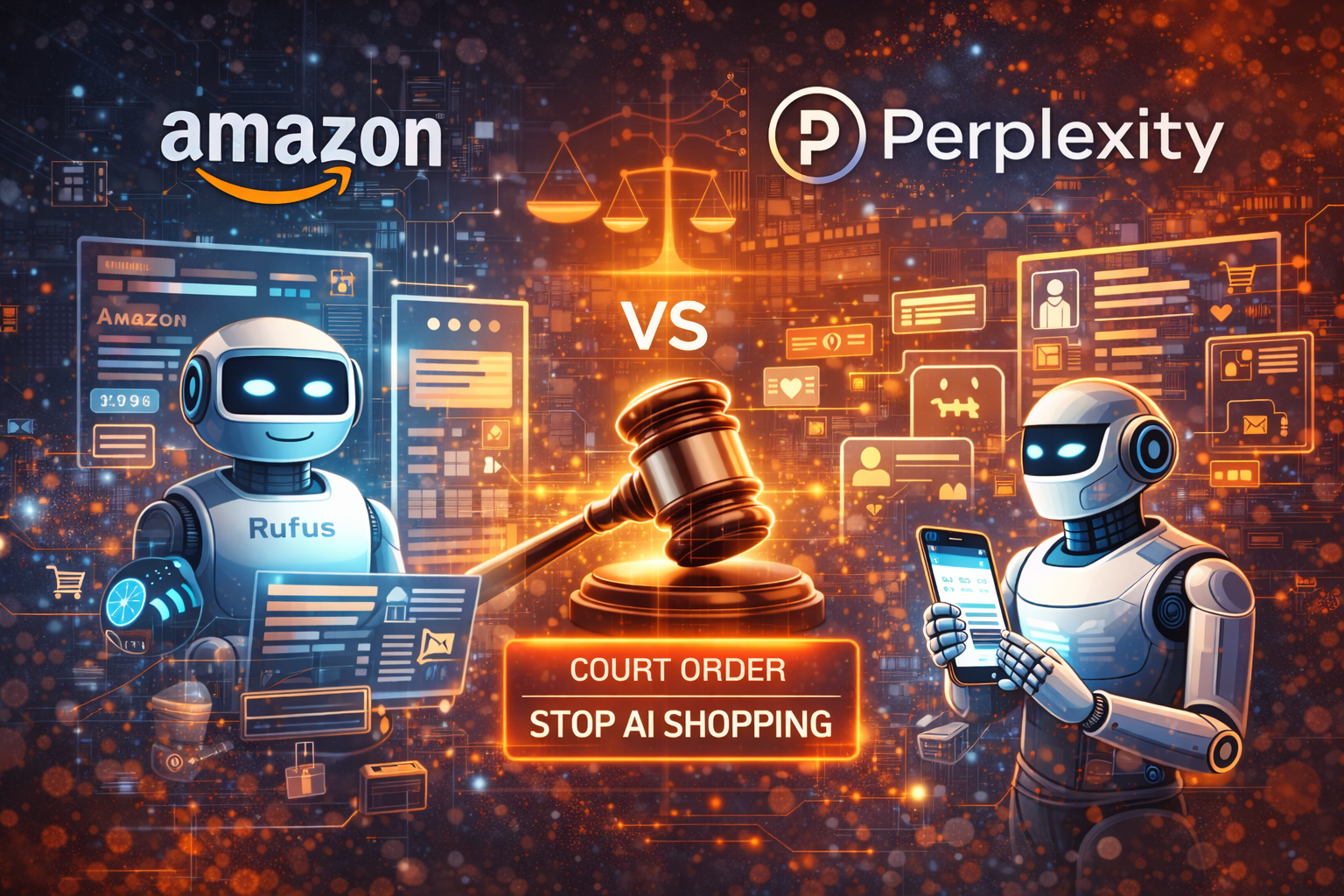
The legal tension between artificial intelligence companies and major commerce platforms reached a new milestone yesterday. A federal judge ordered Perplexity to stop its AI agents from conducting automated shopping activities on Amazon, ruling in favor of Amazon in a dispute that began earlier this year. The lawsuit was originally filed after Amazon alleged that Perplexity’s automated systems were interacting with its platform in ways that violated its terms of service and threatened its control over the emerging future of AI driven commerce. Yesterday’s ruling represents one of the first legal decisions addressing how autonomous AI agents interact with digital marketplaces, signaling that courts are beginning to grapple with the economic and technological implications of agent based commerce.
What the Technologies Were Doing
The dispute revolves around how AI powered browsing and shopping agents interact with online marketplaces.
Perplexity had been developing capabilities through its Comet browser and AI agent platform, designed to act as a digital assistant capable of navigating the internet on behalf of users. Rather than simply answering questions, these agents could search products, compare prices, analyze reviews, and potentially complete purchases automatically.
In effect, the system functioned like a personal shopping agent, executing tasks that traditionally required a human browsing a website.
Amazon, however, has its own artificial intelligence assistant called Rufus, which is integrated directly into the Amazon shopping experience. Rufus is designed to help customers discover products, ask questions, and receive recommendations within Amazon’s ecosystem.
The difference between the two approaches is important.
Perplexity’s agents attempted to operate across the open web, interacting with multiple platforms including Amazon. Rufus, by contrast, is designed to operate inside Amazon’s own platform, keeping the user within the Amazon environment.
This distinction sits at the heart of the dispute.
Amazon’s Motivation: Protecting the Future of Commerce
At first glance, the lawsuit may appear to be a standard dispute about platform terms of service. In reality, the motivations run much deeper.
Amazon has spent decades building what is arguably the most powerful digital commerce platform in the world. If AI agents begin conducting transactions on behalf of users, the structure of online commerce could change dramatically.
In the traditional model, humans browse websites, view product listings, read reviews, and click purchase buttons. Platforms like Amazon control the entire customer journey.
In an agent driven commerce model, however, the user may never visit the website at all. Instead, an AI agent gathers information, compares prices across retailers, and makes a purchase automatically.
In that scenario, the platform risks losing control of the customer interface.
Amazon’s lawsuit can therefore be interpreted as a move to protect its position in the future architecture of digital commerce, ensuring that its own AI systems remain the primary gateway for automated shopping interactions.
Advertising and the Economics of Impressions
Another important dimension of the case involves advertising revenue.
Amazon has become one of the largest advertising platforms in the world. Brands pay to promote products within Amazon’s search results and product pages. The value of these advertisements depends heavily on human impressions and engagement.
If AI agents begin performing the browsing and decision making process instead of humans, the economics of this advertising model change dramatically.
AI agents do not view advertisements in the traditional sense. They are not influenced by colorful banners or persuasive product descriptions. Instead, they analyze structured information such as price, specifications, reviews, and delivery time.
This creates a challenge for platforms like Amazon. If agents become the primary shoppers, companies may no longer be willing to pay for traditional ad placements designed for human eyes.
Platforms would need to redesign advertising systems so they influence algorithmic decision processes rather than human perception.
Such a shift could require entirely new infrastructure for AI commerce advertising. The revenue implications for platforms that currently rely on advertising could be significant.
Data and the Value of Learning Systems
The dispute also has major implications for data ownership.
Every interaction on Amazon generates valuable behavioral data. This includes information about what users search for, what products they compare, what reviews they read, and what they ultimately purchase.
This data feeds recommendation systems, inventory forecasting models, and advertising algorithms.
If external AI agents are allowed to conduct shopping activities on Amazon, those agents may learn from the platform’s data and interactions. Over time, this could enable external systems to build highly sophisticated shopping intelligence without owning the underlying marketplace.
In other words, the data generated through these interactions could help train competing AI agents that eventually guide purchases away from Amazon entirely.
For a company whose competitive advantage depends heavily on data, allowing external agents to freely interact with its marketplace raises important strategic concerns.
Platform Governance and Security
Another dimension worth considering involves platform governance and security.
Automated AI agents interacting with commerce platforms at scale could create challenges in areas such as:
• transaction verification
• fraud detection
• product manipulation
• inventory exploitation
If thousands or even millions of autonomous agents began interacting with commerce systems simultaneously, platforms would need new methods to verify whether those agents represent legitimate users.
This introduces concerns similar to those faced by financial exchanges that must detect algorithmic trading strategies.
By restricting external agents, Amazon may also be attempting to maintain control over the integrity and security of its marketplace.
A Turning Point for Agentic Commerce
The court’s ruling represents more than a simple platform dispute. It highlights a deeper question about how the next generation of commerce will function.
Artificial intelligence agents are rapidly evolving from passive assistants into autonomous digital actors capable of performing complex tasks. Shopping is one of the most obvious applications.
Yet the infrastructure of today’s internet was designed for human users navigating web pages, not for autonomous systems executing transactions on behalf of people.
Yesterday’s ruling suggests that major platforms intend to control how and where AI agents operate within their ecosystems.
This could lead to a future where commerce platforms develop their own proprietary agents and restrict external automation.
Alternatively, new standards could eventually emerge that allow AI agents to interact with commerce platforms through regulated interfaces.
Either way, the decision represents one of the first legal signals shaping how agentic commerce may evolve.
The Road Ahead
The rise of autonomous AI agents is forcing a rethinking of the digital economy.
If agents become the primary interface for many online activities, the balance of power between platforms, consumers, and technology providers may shift dramatically.
For now, the court’s decision reinforces the idea that platform owners still control the rules of engagement within their ecosystems.
But the broader question remains unresolved.
Will the future of commerce be controlled by large platforms and their internal AI systems?
Or will independent AI agents become the dominant intermediaries between consumers and the digital marketplace?
Yesterday’s ruling does not settle that debate.
It simply marks the moment when the legal system officially entered the conversation.