
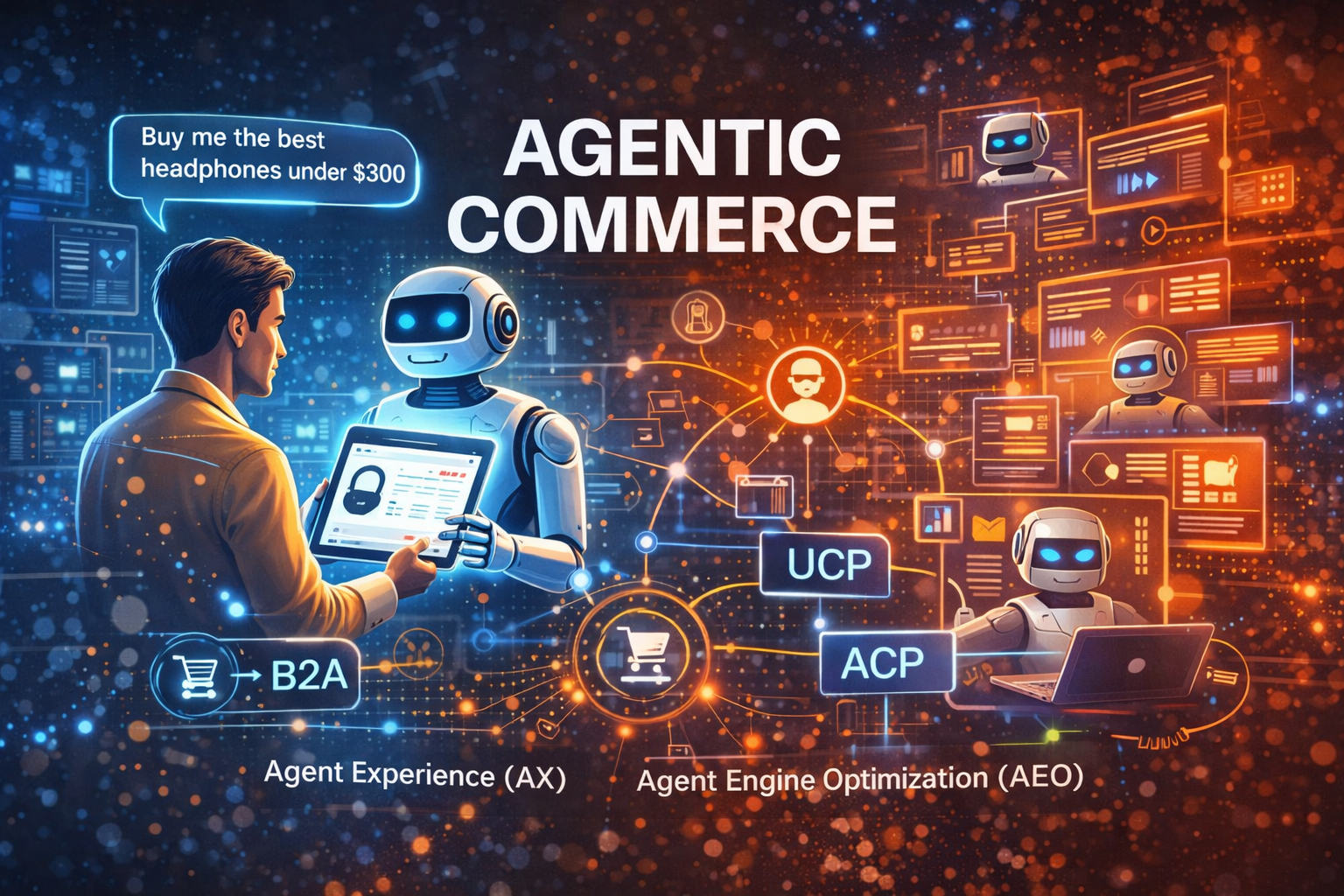
From Clicking to Delegating
For decades, shopping online has followed a familiar pattern. You search, scroll, compare, hesitate, read reviews, open ten tabs, sleep on it, close nine, and finally click “Buy Now.” It is a very human process—messy, emotional, and sometimes irrational.
Now imagine removing yourself from that process.
Instead of browsing, you simply say:
“Find me the best noise-canceling headphones under $300 with great battery life and fast delivery.”
And then… nothing. No scrolling. No ads. No indecision.
An AI Agent does everything for you.
Welcome to Agentic commerce—a world where AI agents don’t just assist with shopping… they become the shopper.
AI Agents: From Tools to Customers
Traditionally, AI has been a tool—something that helps you search, recommend, or automate parts of a workflow.
That model is changing fast.
AI agents are now evolving into autonomous decision-makers. They can:
- Understand your preferences
- Compare products across platforms
- Evaluate trade-offs like price vs quality
- Execute transactions on your behalf
This leads to a fundamental shift:
AI Agents are no longer tools. They are the customers.
This introduces a new paradigm:
B2A – Business to Agent commerce
Instead of optimizing for human buyers, businesses must now design for machine decision-makers.
And machines, as it turns out, shop very differently than humans.
Humans vs Agents: A Completely Different Shopper
Let’s be honest. Humans are not always rational shoppers.
We are influenced by:
- Shiny objects
- Flashy discounts
- Attractive images
- “Only 2 left in stock!” panic
- Emotional language
- Brand perception
AI agents, on the other hand, do not care about any of this.
They care about:
- Structured data
- Verified reviews
- Product specifications
- Delivery timelines
- Price efficiency
An AI Agent will not be impressed by a dramatic product description like:
“Experience the ultimate sound journey like never before!”
Instead, it will ask:
“What is the frequency response? What is the latency? What is the failure rate?”
Not exactly poetic.
Websites Built for Humans Won’t Work for Agents
Today’s ecommerce websites are designed for human eyes and behavior:
- Visual layouts
- Navigation menus
- Product images
- Marketing copy
- Personalized recommendations
In agentic commerce, these elements become… mostly irrelevant.
AI agents do not “browse” in the traditional sense. They crawl, parse, and reason over data.
This means businesses must rethink their digital presence.
From UI/UX → Agent Experience (AX)
User Experience (UX) becomes less important than Agent Experience (AX).
Instead of asking:
“Is this page visually appealing?”
The question becomes:
“Can an AI agent efficiently understand and evaluate this product?”
From SEO to AEO: A New Optimization Game
Search Engine Optimization (SEO) has long been the foundation of digital commerce.
The goal: rank higher on Google so humans click your link.
In agentic commerce, the goal changes to:
AEO – Agent Engine Optimization
You are no longer optimizing for humans clicking links.
You are optimizing for AI Agents selecting your product.
This introduces new dynamics:
- Agents may not care about your homepage
- They may never “see” your brand
- They may skip your site entirely if your data is not structured properly
In fact, your beautifully designed website could be completely ignored if your machine-readable data is poor.
Harsh, but fair.
How LLMs Change Decision Making
Large Language Models (LLMs) power most modern AI agents. These models:
- Crawl and synthesize information
- Compare multiple sources
- Infer quality from patterns
- Generate recommendations
Unlike humans, LLMs do not rely on a single source. They build a composite understanding.
This creates two major implications:
1. No Single Source of Truth
Your website is no longer the only place where decisions are made. Agents may combine:
- Product pages
- Reviews
- Forums
- Third-party comparisons
2. Consistency Matters More Than Marketing
If your product claims one thing but reviews say another, the agent will detect the inconsistency.
Humans might overlook it. Agents won’t.
Sponsored Listings? Agents Don’t Care
One of the most interesting disruptions is advertising.
Today, ecommerce thrives on:
- Sponsored listings
- Paid placements
- Banner ads
But here’s the problem:
Agents do not understand or value “sponsored.”
They do not think:
“This product is at the top, so it must be better.”
Instead, they think:
“This product is at the top… why?”
If the answer is “because someone paid for it,” the agent will likely ignore it.
This forces a major shift:
- From paying for visibility
- To earning selection through data quality and relevance
What Does Content for AI Agents Look Like?
If agents are the new customers, content must evolve.
Traditional Content (for humans):
- Emotional language
- Visual storytelling
- Brand messaging
Agent-Friendly Content:
- Structured product attributes
- Clear specifications
- Standardized formats
- Verified performance metrics
Think of it this way:
Humans read stories.
Agents read data models.
Building Machine-Readable Product Data
To succeed in agentic commerce, businesses must invest in machine-readable data.
This includes:
- Standardized product schemas
- APIs exposing product information
- Real-time inventory and pricing data
- Verified customer reviews in structured form
Instead of writing:
“Long-lasting battery life”
You provide:
- Battery life: 32 hours
- Charging time: 1.5 hours
- Degradation rate: <5% per year
Less marketing. More math.
Agents Talk to Agents: The Rise of Protocols
Another major shift is how transactions happen.
AI agents do not manually navigate websites. They communicate through protocols.
Some emerging frameworks include:
- UCP (Universal Commerce Protocol)
- ACP (Agent Communication Protocol)
- MCP (Model Context Protocol)
These protocols allow:
- Agents to request product data
- Systems to respond in standardized formats
- Transactions to occur across platforms
This creates an inter-enterprise agent ecosystem where:
- Your agent talks to a retailer’s agent
- The retailer’s agent talks to a logistics agent
- The logistics agent confirms delivery
All without human involvement.
It is like a group chat… except no one forgets to reply.
A Subtle but Powerful Shift: Brand Becomes Invisible
One of the more surprising outcomes of agentic commerce is the reduced importance of brand visibility.
If an agent is making the decision, the user may never see:
- Your website
- Your logo
- Your marketing
The agent simply returns:
“This is the best option.”
This raises an uncomfortable question:
If the agent chooses the product, who owns the customer relationship?
Humor Break: The Future of Shopping
Let’s imagine a typical future interaction:
You: “Buy me a good laptop.”
Agent: “Done.”
You: “Which one?”
Agent: “The best one.”
You: “Based on what?”
Agent: “Trust me.”
Congratulations. You have outsourced not just shopping… but curiosity.
Challenges and Open Questions
Agentic commerce is exciting, but it raises important questions:
1. Trust
Will consumers trust agents to make high-value decisions?
2. Bias
What if agents favor certain vendors based on training data?
3. Transparency
Will users understand why a product was chosen?
4. Control
Can users override or guide agent decisions?
5. Regulation
Who is responsible if an agent makes a bad purchase?
These questions are still evolving, and the answers will shape the future of commerce.
What Businesses Must Do Now
To prepare for agentic commerce, businesses should:
1. Structure Their Data
Invest in machine-readable product information.
2. Build APIs
Allow agents to access data programmatically.
3. Focus on Truth, Not Hype
Ensure consistency across all information sources.
4. Rethink Marketing
Shift from persuasion to decision support.
5. Experiment Early
Agentic commerce is still emerging. Early movers will define the standards.
The Quiet Revolution
Agentic commerce will not arrive with a dramatic announcement.
There will be no single moment where everything changes.
Instead, it will happen quietly, first slowly and then all at once:
- Fewer clicks
- Fewer searches
- More delegation
Until one day, you realize:
You have not “shopped” in weeks.
Your agents have.
And businesses that once competed for your attention will now compete for your agent’s approval.
Final Thought
In the past, the golden rule of commerce was:
“The customer is always right.”
In the future, it may become:
“The agent is always… efficient.”
Not always right.
But definitely faster.