
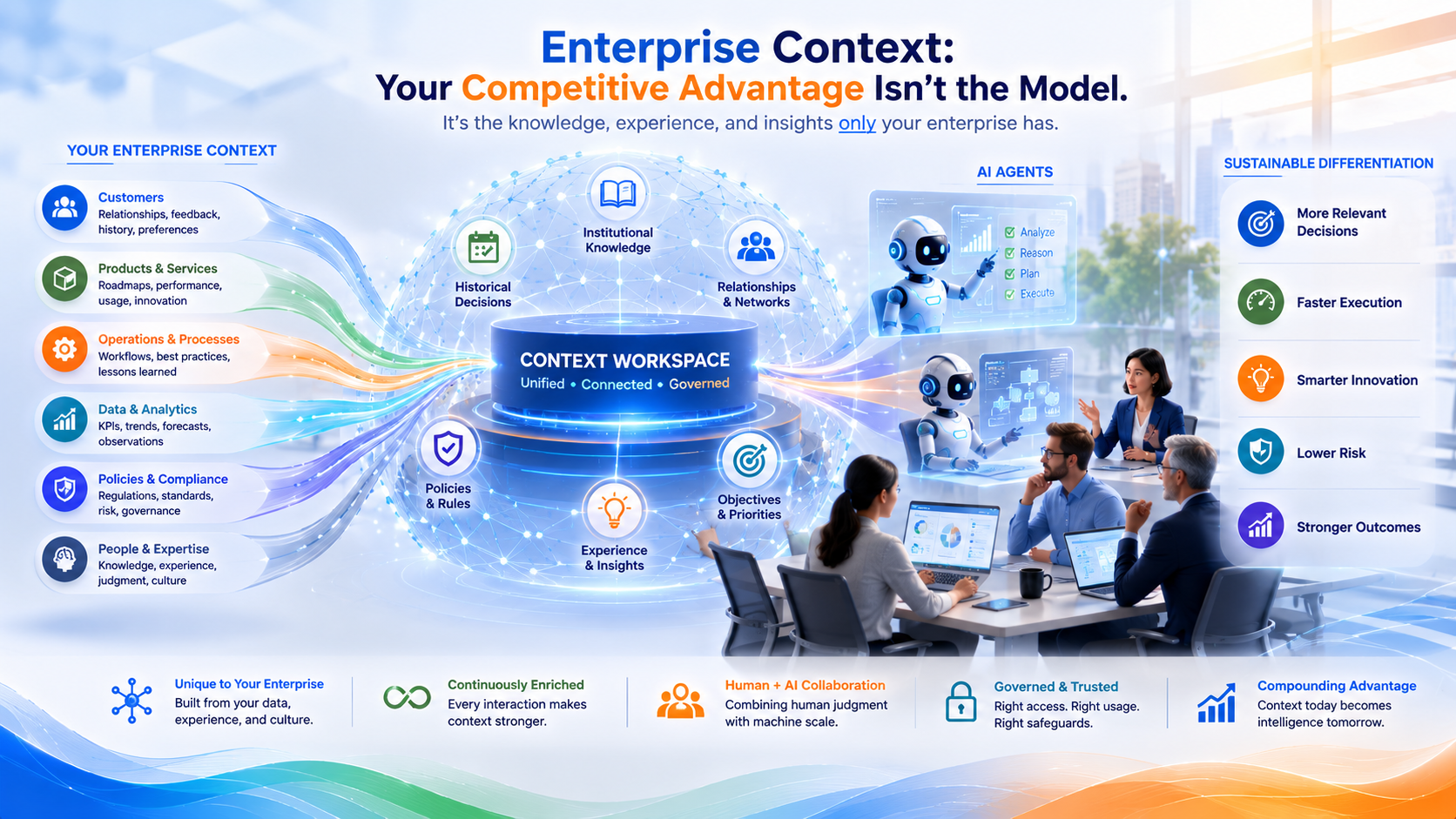
As enterprise AI adoption accelerates, organizations are gaining access to many of the same increasingly capable models. A frontier model available to one enterprise is often available to its competitors. Open-source models and advanced techniques of model distillation further democratize access to sophisticated AI capabilities. This raises an important question: If everyone has access to similar AI intelligence, where does sustainable differentiation come from?
Increasingly, the answer is Context.
Every enterprise possesses a body of knowledge that no foundation model inherently understands – customer relationships, historical decisions, successes and failures, organizational practices, product histories, operational processes, policies, and the accumulated expertise of its people. Together, these represent an organization’s institutional memory, knowledge developed through years, sometimes decades, of operating experience.
A powerful model can reason about a supply-chain problem. But it does not inherently know why your organization selected a particular supplier three years ago, which alternatives were considered, what contractual commitments exist, which product dependencies are affected, or what happened the last time a similar disruption occurred. That difference matters.
The model provides intelligence.
Enterprise context makes that intelligence yours.
Building that advantage begins with the Context Workspace. Rather than allowing enterprise knowledge to remain fragmented across applications, databases, communications, documents, and individual employees, the Context Workspace creates a living body of knowledge, relationships, policies, experiences, and objectives that humans and AI Agents can continuously consume and enrich.
But merely accumulating information in another repository is not enough. Context Engineering provides the discipline for collecting, organizing, enriching, connecting, protecting, and delivering that knowledge. Semantic relationships can connect information that previously existed in isolation. Retrieval mechanisms identify what matters to a particular task. Identity and access controls determine what an Agent is permitted to know. Orchestration then brings the appropriate context into an Agent’s reasoning and actions. The result is fundamentally different from simply giving employees access to an LLM.
Imagine two competing organizations using the same frontier model to evaluate a product opportunity. One provides a prompt supplemented with a few documents. The other can contextualize the opportunity against customer feedback, competitive intelligence, historical product decisions, engineering constraints, financial objectives, supplier relationships, regulatory requirements, and lessons learned from previous launches.
Same model.
Different context.
Very different intelligence.
And there is an important compounding effect. AI Agents do not have to be passive consumers of enterprise context. As agents interact with customers, analyze operations, investigate problems, execute workflows, and collaborate with employees, they generate new observations and outcomes. When those insights are contributed back into the Context Workspace, individual learning can become collective enterprise intelligence available to other authorized humans and Agents.
Technology alone, however, will not create this advantage. Organizations will need to develop a culture of context, one that treats institutional knowledge as a strategic asset rather than a by-product of daily work. Important decisions need context. Outcomes need to be captured, relationships need to be preserved, employees need mechanisms and incentives to contribute expertise, and AI Agents need to enrich, rather than simply consume organization’s contextual foundation.
Over time, this creates something competitors cannot easily replicate. They may acquire the same model. They may deploy similar infrastructure. They may even implement comparable Agentic AI capabilities. What they cannot readily acquire is the context your organization has accumulated through its own experiences, decisions, relationships, and expertise. That may ultimately be one of the most durable competitive advantages of enterprise AI – not simply having access to intelligence but building the contextual foundation that makes that intelligence uniquely relevant to your enterprise.
In our next post, we move from the enterprise to the individual: Personal Context — When AI Begins to Understand You, exploring how persistent personal context can evolve AI from a generic assistant toward a knowledgeable digital counterpart.
To explore the broader thesis, request the Reasoned Insights white paper, Context Is All You Need!