
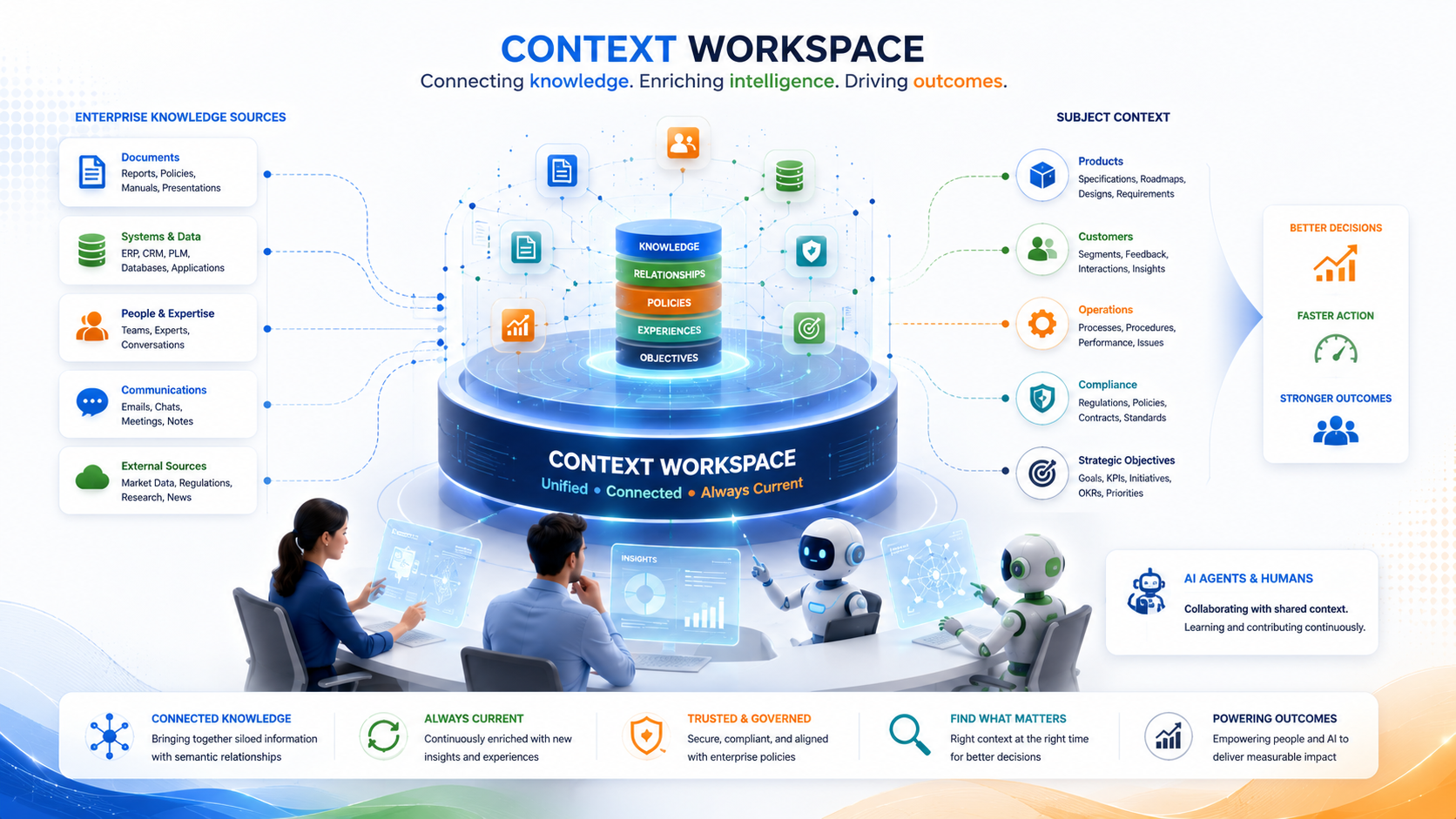
Most enterprises do not have a shortage of knowledge. In fact, they are inundated with new information every day. Yet modern organizations often find themselves trapped in a cycle of rediscovering what they already know. The challenge is not simply accumulating more knowledge, but connecting, contextualizing, and applying what the enterprise already knows.
Knowledge exists everywhere – databases, applications, customer interactions, operational systems, project histories, documents, policies, and perhaps most importantly, within the experience of employees. Traditional repositories help organizations store and retrieve pieces of this information, but enterprise intelligence depends on something richer: understanding how those pieces relate to one another and which ones matter to the task at hand.
This is where the concept of a Context Workspace becomes important.
A Context Workspace is not simply another knowledge repository. It represents a living body of knowledge, relationships, policies, experiences, and objectives relevant to a particular area of work. By uncovering semantic relationships across enterprise information, it connects otherwise fragmented knowledge and provides richer meaning and context. Rather than presenting AI with an undifferentiated collection of information, the Context Workspace can progressively narrow broad organizational knowledge to the specific context required for a particular problem or decision.
Consider a product launch. Product Management understands market requirements and priorities. Engineering understands design constraints. Supply Chain understands supplier dependencies. Finance understands economics. Legal understands regulatory and contractual obligations. Sales understands customer commitments. Individually, each function possesses only part of the picture.
A Context Workspace connects these perspectives.
Now consider an AI Agent asked whether a product launch can be accelerated by six weeks. Finding the project schedule is useful, but insufficient. An intelligent answer may also require resource availability, supplier lead times, manufacturing capacity, regulatory approvals, contractual commitments, and other dependencies. The value comes not merely from retrieving information, but from understanding the relationships surrounding the decision.
And importantly, the workspace is not static. As people and AI Agents perform work, they generate new insights, decisions, exceptions and outcomes. Those experiences can flow back into the Context Workspace, preserving institutional knowledge and making it available for future interactions. The workspace therefore becomes both a source and destination of enterprise intelligence.
This becomes especially powerful with Agentic AI. Rather than operating as isolated assistants, specialized agents can consume context from a shared workspace while contributing what they learn back into it. A procurement agent learns from supplier interactions; an operations agent identifies recurring bottlenecks; a customer-service agent recognizes emerging issues. When these insights become available across authorized agents and people, individual learning begins to become collective enterprise intelligence.
That changes the role of enterprise knowledge. Instead of repeatedly rediscovering what the organization already knows, enterprises can build a contextual foundation that becomes richer as the organization operates.
The Context Workspace is where enterprise knowledge stops being stored information and starts becoming usable intelligence.
But creating such a workspace raises the next question: How do we collect, organize, enrich, connect, protect and deliver the right context at the right time? That is the subject of the next post in this series: Context Engineering — Turning Enterprise Knowledge into AI Intelligence.
To explore the broader thesis, request the Reasoned Insights white paper, Context Is All You Need!