
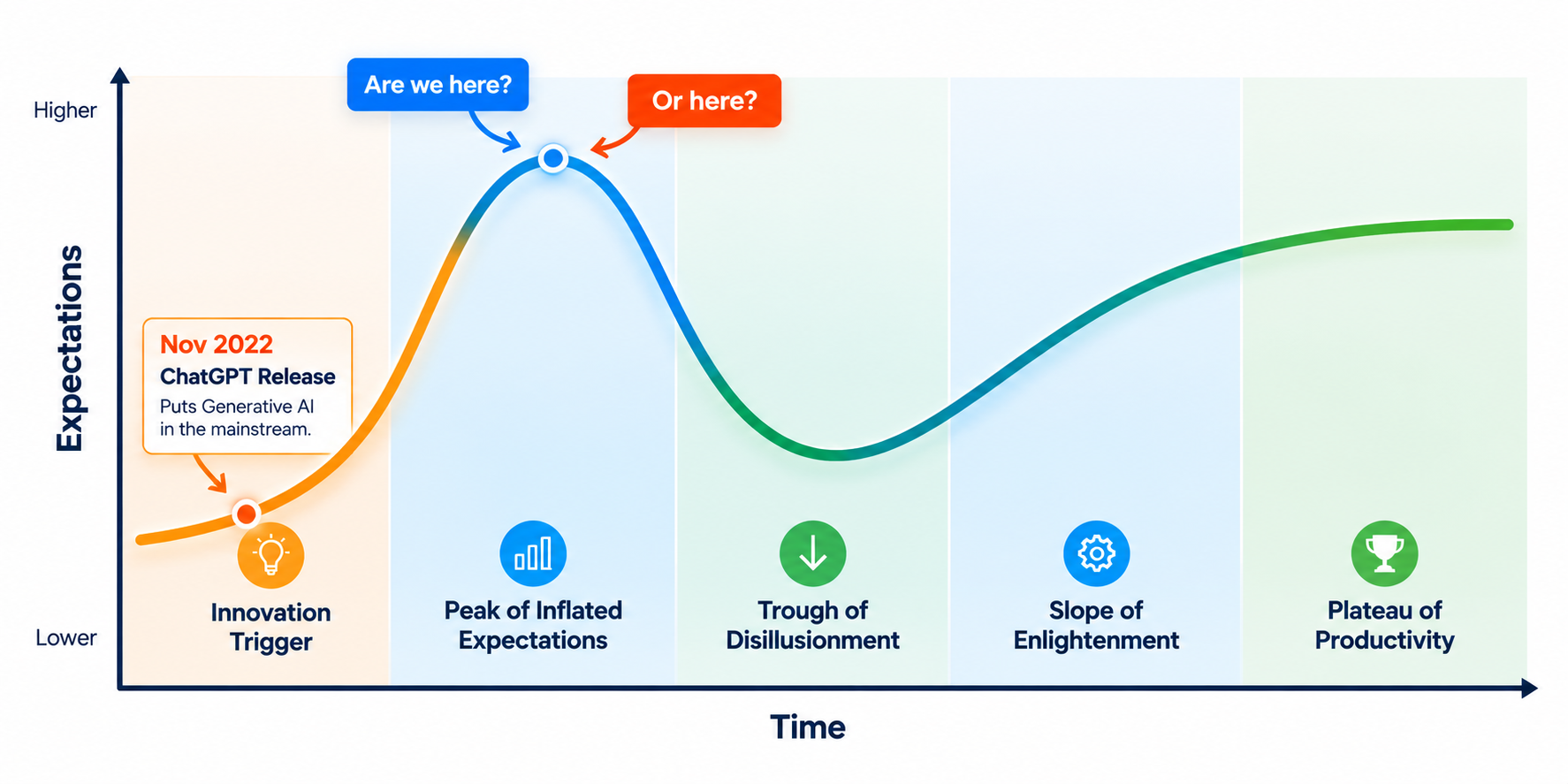
In November 2022, ChatGPT arguably triggered one of the most extraordinary technology adoption cycles in recent history. Nearly four years later, the enthusiasm remains palpable, hundreds of millions of subscribers, investments continue to soar, and AI capabilities advance at a breathtaking pace. But an uncomfortable question is emerging: Where is the measurable economic payoff for corporate America?
In an October 24, 2026 article, Torsten Slok of Apollo Global Management presents some thought-provoking evidence. His analysis suggests that the financial benefits of AI remain heavily concentrated among the Magnificent Seven technology companies, with little observable improvement across the remaining S&P 493.
This raises an intriguing question when viewed through the Gartner Hype Cycle. Having experienced the Innovation Trigger and extraordinary enthusiasm surrounding Generative and Agentic AI, are we approaching the Peak of Inflated Expectations, or have we already begun descending toward the Trough of Disillusionment?
The evidence: Three revealing charts

Revenue per worker
Revenue per employee is rising among the Magnificent Seven but remains comparatively flat across the S&P 493. Is AI creating productivity gains primarily for its suppliers rather than its enterprise customers?

Corporate profit margins
Technology leaders are enjoying expanding margins, while the broader market remains relatively stagnant. Are enterprise AI investments failing to translate into bottom-line improvements, or are returns simply taking longer to materialize?

Economy-wide productivity
Despite AI adoption, the productivity indicators show no unmistakable AI-driven acceleration. Could localized productivity improvements be too small, too recent, or too unevenly distributed to register nationally?
Where do we go from here?
Perhaps the real challenge is not AI capability but converting capability into measurable business outcomes. Are enterprises investing in technology before redesigning workflows, preparing their data, establishing meaningful ROI metrics, and equally importantly training their workforce for AI adoption?
Or is this simply the familiar pattern of transformative technologies, where expectations race ahead of adoption, organizational change, and eventual economic returns?
Are we witnessing the beginning of AI disillusionment, or the necessary transition from experimentation to disciplined value creation?
That distinction may determine who ultimately benefits from the AI revolution.