
In the previous post, we introduced the Context Workspace as a living body of enterprise knowledge, relationships, policies, experiences, and objectives, a shared environment that humans and AI Agents can continuously consume and enrich.
But a Context Workspace does not build itself.
Enterprise knowledge is fragmented across databases, applications, communications, operational systems, documents and people. Much of it was created for human consumption, not for AI. Making that knowledge useful to intelligent systems requires a deliberate discipline for determining what context matters, how it is organized, how relationships are established, how it is protected, and how the right context reaches the right AI Agent at the right time.
That discipline is Context Engineering.
Think of Context Engineering as the architectural and engineering foundation beneath the Context Workspace. It moves the conversation from what context is to how context becomes operational.
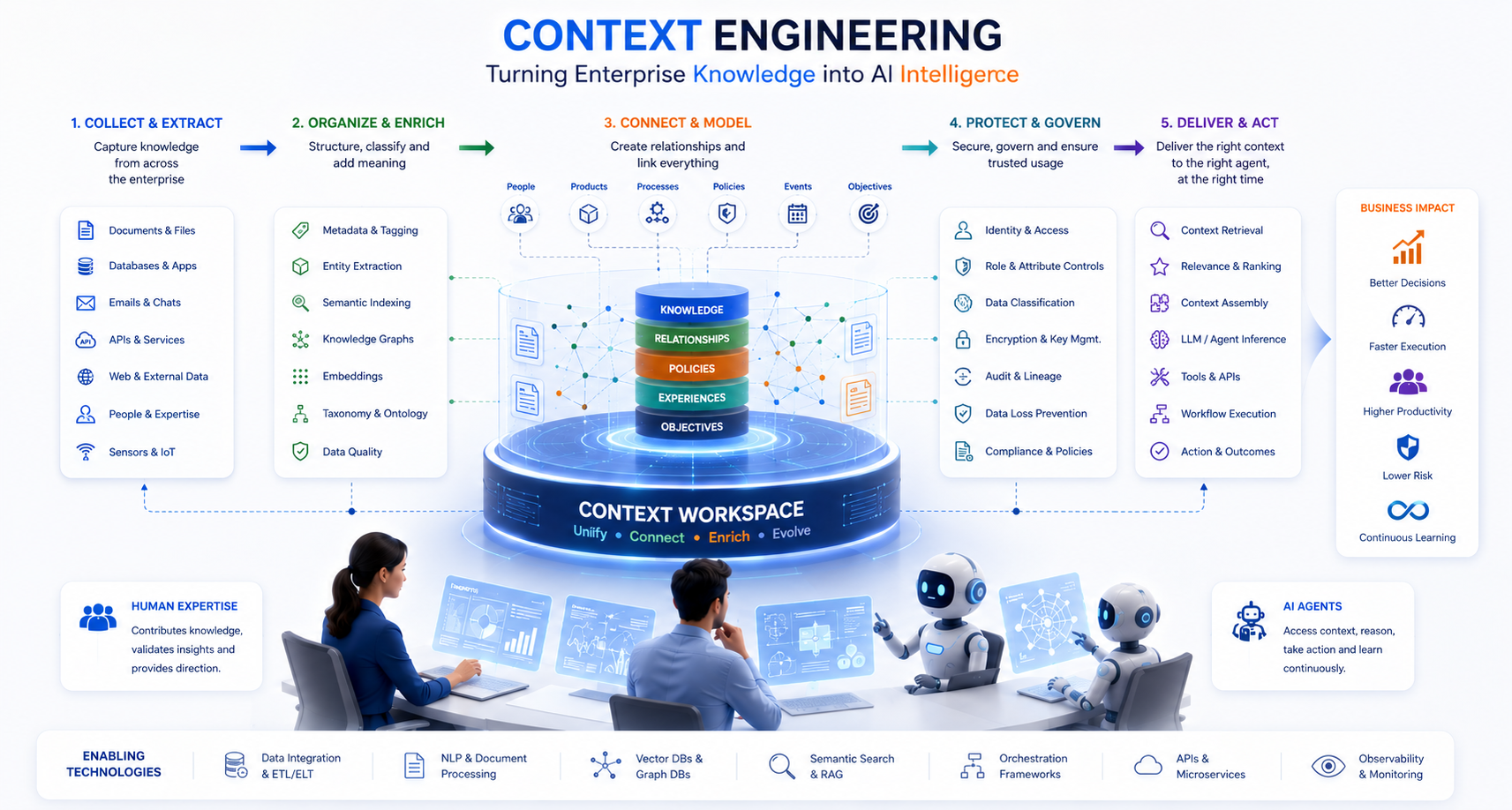
It begins with collecting and extracting knowledge. Enterprise information may originate in collaboration platforms, structured databases, business applications, emails, APIs, external sources, documents and real-time event streams. Technologies such as document parsing, OCR, speech transcription, metadata extraction, entity recognition, semantic classification, and relationship discovery transform this heterogeneous information into knowledge that can be understood and used by AI systems.
The next challenge is organizing and enriching that knowledge. Simply moving enterprise information into another repository does not create context. Metadata helps identify what something is. Embeddings help identify semantic similarity. Knowledge graphs can expose relationships among customers, products, suppliers, employees, regulations, and processes. Vector databases, graph databases, metadata catalogs, relational databases, object stores, and semantic indexes each play complementary roles. Together, these technologies allow the Context Workspace to move beyond storing information toward understanding how enterprise knowledge is connected.
Then comes retrieval and delivery. An AI Agent rarely needs everything the enterprise knows. It needs the subset relevant to the task, user, objective, and moment. Retrieval mechanisms can progressively narrow the available knowledge, assemble the appropriate context, and provide it to an LLM or Agent before reasoning occurs. The LLM therefore does not need to become the repository of enterprise knowledge, it performs inference against a persistent and continuously evolving contextual infrastructure.
This creates an architectural progression:
Enterprise Sources
Ingestion & Enrichment
Context Workspace
Contextual Retrieval
LLM & Agent Reasoning
Enterprise Action
Above this foundation sits the Agentic AI orchestration layer. Specialized agents may retrieve information, reason, plan, validate, enforce policies, invoke APIs, execute workflows, and collaborate with other agents. The orchestration platform coordinates task sequencing, workflow state, and context sharing while keeping those activities grounded in the appropriate Context Workspace.
There is another dimension that cannot be separated from the architecture: protection. A Context Workspace may eventually contain some of an organization’s most valuable intellectual property and institutional knowledge. Context therefore cannot simply be retrieved because it is relevant – it must also be authorized. Identity management, access controls, encryption, data classification, auditability, lineage, provenance, and continuous monitoring become integral parts of Context Engineering. The right context must reach the right Agent, but only when that Agent and the person on whose behalf it operates are entitled to use it.
This is why Context Engineering is considerably broader than prompt engineering or even RAG. Prompts influence an interaction. RAG retrieves relevant information. Context Engineering creates and manages the persistent contextual infrastructure within which enterprise AI operates.
And that infrastructure should never be static. Markets evolve, customers interact, regulations evolve, new decisions are made, products change, Agents discover insights and humans contribute expertise. Each interaction creates an opportunity to enrich the Context Workspace so that future decisions begin with more organizational understanding than the ones before them.
Models provide intelligence.
Context Engineering connects that intelligence to the enterprise.
Agentic AI puts it to work.
But what exactly makes enterprise context uniquely valuable, and potentially a source of competitive differentiation? That is where we go next: Enterprise Context — Your Competitive Advantage Isn’t the Model.
To explore the complete thesis behind the series, request the Reasoned Insights white paper, Context Is All You Need!