
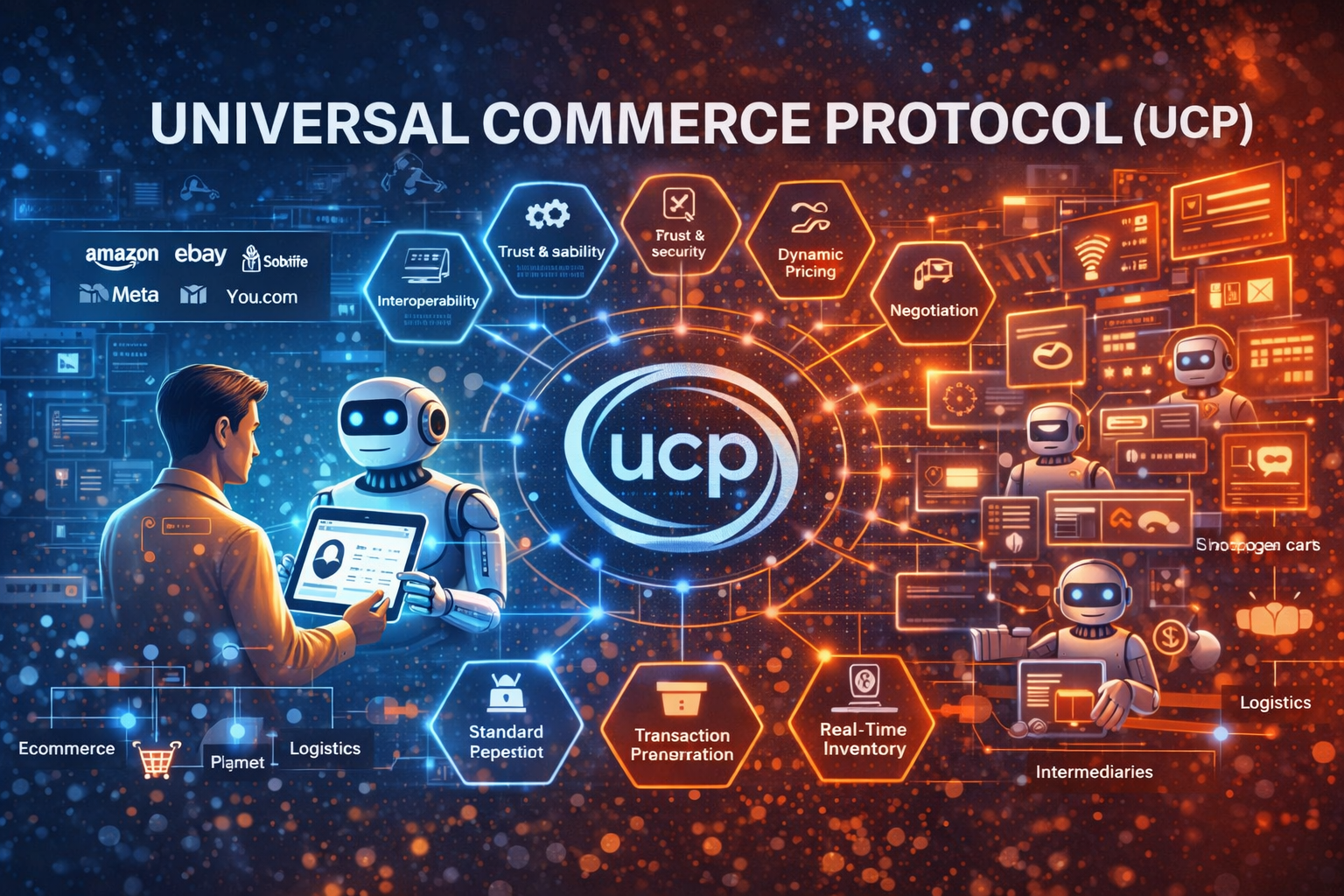
What is the Universal Commerce Protocol?
The Universal Commerce Protocol (UCP) is an emerging open standard designed to enable seamless, machine-to-machine commerce in a world increasingly driven by AI agents. At its core, UCP provides a structured way for systems—especially AI agents—to discover products, evaluate options, negotiate transactions, and execute purchases across different platforms without requiring human intervention.
Unlike traditional ecommerce frameworks that are optimized for human browsing, UCP is built for a new reality where software agents act on behalf of consumers and businesses. It is intended to standardize how commerce data is shared and how transactions are conducted across disparate systems.
UCP is being developed as an open source initiative, with growing interest from a range of stakeholders including:
- Ecommerce platforms
- Payment providers
- Logistics companies
- AI and cloud platform vendors
- Retailers and marketplaces
The open nature of UCP is critical. Commerce has historically been fragmented, with each platform building its own ecosystem. UCP aims to break down these silos and create a common language for digital commerce, much like HTTP did for the web.
Why Do We Need Protocols Like UCP?
To understand the need for UCP, it is important to recognize how commerce is evolving.
Traditional ecommerce assumes a human user:
- Browsing websites
- Clicking through product pages
- Comparing options visually
- Making purchase decisions manually
This model is fundamentally incompatible with AI agents.
AI agents do not “browse” in the traditional sense. They:
- Query structured data
- Evaluate options algorithmically
- Optimize for constraints such as price, delivery, and quality
- Execute decisions programmatically
Without a standardized protocol, every integration between an AI agent and a commerce platform becomes a custom engineering effort. This creates friction, limits scalability, and slows innovation.
UCP addresses this by providing:
- A standard interface for product discovery
- A common schema for product and pricing data
- A transaction framework for executing purchases
- A communication layer for agents and systems
In essence, UCP enables interoperability—allowing AI agents to operate across multiple platforms without needing bespoke integrations for each one.
Another important driver is the rise of B2A (Business to Agent) commerce. As AI agents become primary decision-makers, businesses must interact not just with human customers, but with digital intermediaries that represent them. UCP provides the infrastructure to support this shift.
Key Features of the Universal Commerce Protocol
UCP is designed with several foundational capabilities that enable agentic commerce at scale.
1. Standardized Product Representation
UCP defines a consistent way to represent products, including:
- Specifications
- Pricing
- Availability
- Delivery options
- Reviews and ratings
This structured format ensures that AI agents can easily parse and compare products across different vendors. Instead of scraping web pages, agents can directly access clean, machine-readable data.
2. Dynamic Pricing and Inventory Access
One of the challenges in commerce is that pricing and inventory are constantly changing.
UCP allows systems to expose real-time data, enabling agents to:
- Access up-to-date pricing
- Check inventory availability
- Evaluate delivery timelines
This reduces the risk of stale data and improves decision accuracy.
3. Transaction Orchestration
UCP provides a framework for executing transactions end-to-end.
This includes:
- Order placement
- Payment processing integration
- Confirmation workflows
- Fulfillment coordination
Rather than navigating multiple APIs across different systems, agents can rely on a unified transaction model.
4. Negotiation and Constraints Handling
Unlike traditional ecommerce, agentic commerce often involves constraint-based decision-making.
For example:
- Budget limits
- Delivery deadlines
- Brand preferences
- Sustainability requirements
UCP allows agents to communicate these constraints and receive responses that align with them. This opens the door to automated negotiation and optimization.
5. Identity and Trust Frameworks
Trust is critical in any commerce system.
UCP incorporates mechanisms for:
- Verifying participating entities
- Ensuring secure transactions
- Managing authentication and authorization
This helps establish confidence between buyers, sellers, and intermediaries in an automated environment.
6. Interoperability Across Ecosystems
Perhaps the most important feature is interoperability.
UCP is designed to work across:
- Retail marketplaces
- Payment networks
- Logistics providers
- Enterprise systems
This allows agents to orchestrate complex workflows involving multiple parties without being locked into a single platform.
Benefits of UCP for Businesses and the Ecosystem
The adoption of UCP has the potential to unlock significant value across the commerce ecosystem.
1. Reduced Integration Complexity
Businesses no longer need to build custom integrations for every platform or partner. By adopting UCP, they can connect to a standardized ecosystem, reducing development time and cost.
2. Access to Agent-Driven Demand
As AI agents become primary shoppers, businesses that support UCP will be better positioned to:
- Be discovered by agents
- Participate in automated decision-making
- Capture demand that may never pass through traditional channels
This is especially important in a world where agents may bypass websites entirely.
3. Improved Efficiency and Automation
UCP enables end-to-end automation of commerce workflows.
This includes:
- Product discovery
- Order processing
- Inventory management
- Fulfillment coordination
The result is greater operational efficiency and reduced manual intervention.
4. Enhanced Customer Experience (Indirectly)
While humans may not directly interact with UCP, they benefit from:
- Faster purchasing decisions
- Better product matches
- Reduced friction in transactions
In many ways, UCP enables a “set it and forget it” commerce experience, where agents handle the complexity behind the scenes.
5. Leveling the Playing Field
Smaller businesses often struggle to compete with large platforms that dominate traffic and visibility.
UCP shifts the focus from:
- Brand visibility
- Advertising spend
to:
- Data quality
- Product relevance
- Competitive pricing
This creates opportunities for smaller players to compete more effectively in an agent-driven marketplace.
6. New Business Models
UCP opens the door to entirely new business models, such as:
- Agent marketplaces
- Automated procurement systems
- Dynamic pricing engines
- AI-driven supply chains
These innovations could reshape how commerce operates at both consumer and enterprise levels.
Challenges and Open Questions
Despite its promise, UCP faces several challenges that must be addressed for widespread adoption.
1. Standardization vs Fragmentation
Achieving consensus on a universal protocol is difficult.
Different stakeholders may have competing interests, leading to:
- Multiple competing standards
- Partial implementations
- Fragmentation across ecosystems
Without broad adoption, the benefits of UCP may be limited.
2. Data Quality and Consistency
UCP relies heavily on structured, accurate data.
If businesses provide:
- Incomplete data
- Inconsistent formats
- Misleading information
the effectiveness of agent-based decision-making will be compromised.
Ensuring high-quality data across the ecosystem is a significant challenge.
3. Trust and Security Concerns
Automated commerce introduces new risks, including:
- Fraudulent transactions
- Malicious agents
- Data breaches
Building robust trust and security frameworks will be critical to adoption.
4. Impact on Existing Revenue Models
As discussed in agentic commerce more broadly, UCP could disrupt traditional revenue streams such as:
- Advertising
- Sponsored listings
- Platform fees
Businesses that rely on these models may resist adoption or seek to reshape the protocol to protect their interests.
5. Regulatory and Compliance Issues
Commerce is heavily regulated, particularly in areas such as:
- Payments
- Data privacy
- Consumer protection
UCP must align with regulatory requirements across different regions, adding complexity to its implementation.
6. Loss of Direct Customer Relationship
In a UCP-driven world, businesses may interact more with agents than with humans.
This raises concerns about:
- Brand visibility
- Customer loyalty
- Direct engagement
Companies will need to rethink how they build relationships in an agent-mediated environment.
The Infrastructure of the Next Commerce Era
The Universal Commerce Protocol represents a foundational shift in how commerce is conducted.
Just as the internet required protocols like HTTP to enable global connectivity, agentic commerce requires protocols like UCP to enable seamless interaction between systems.
UCP is not just a technical standard. It is a strategic enabler of a new commerce paradigm where:
- AI agents act as primary decision-makers
- Businesses compete on data and relevance rather than visibility
- Transactions are automated across interconnected ecosystems
While challenges remain, the direction is clear.
Commerce is moving from:
Human-driven, interface-based interactions
to
Agent-driven, protocol-based ecosystems
For business leaders, the question is no longer whether this shift will happen.
The question is:
Will your business be accessible to the agents making the decisions?
Because in the near future, if you are not speaking the language of UCP… you may not be part of the conversation at all.
To learn more about the UCP protocol follow the link here.