
Industry
Cross-Industry | Data-Intensive Organizations | Professional Services | AI-Enabled Enterprises | Financial Services | Technology
Business Challenge
As enterprises scale Generative and Agentic AI, the economics of model consumption become increasingly important. Sending every request, along with extensive supporting context, directly to a frontier model can drive significant token consumption, increase inference costs, and introduce unnecessary latency, even when many requests can be adequately addressed using smaller or open-source models.
At the same time, optimizing solely for cost can compromise response quality when complex questions require the reasoning capabilities and broader knowledge of frontier models.
The challenge is therefore to determine how much context is required, which model should process it, and when the additional capabilities of a frontier model justify the incremental cost.
Solution Approach
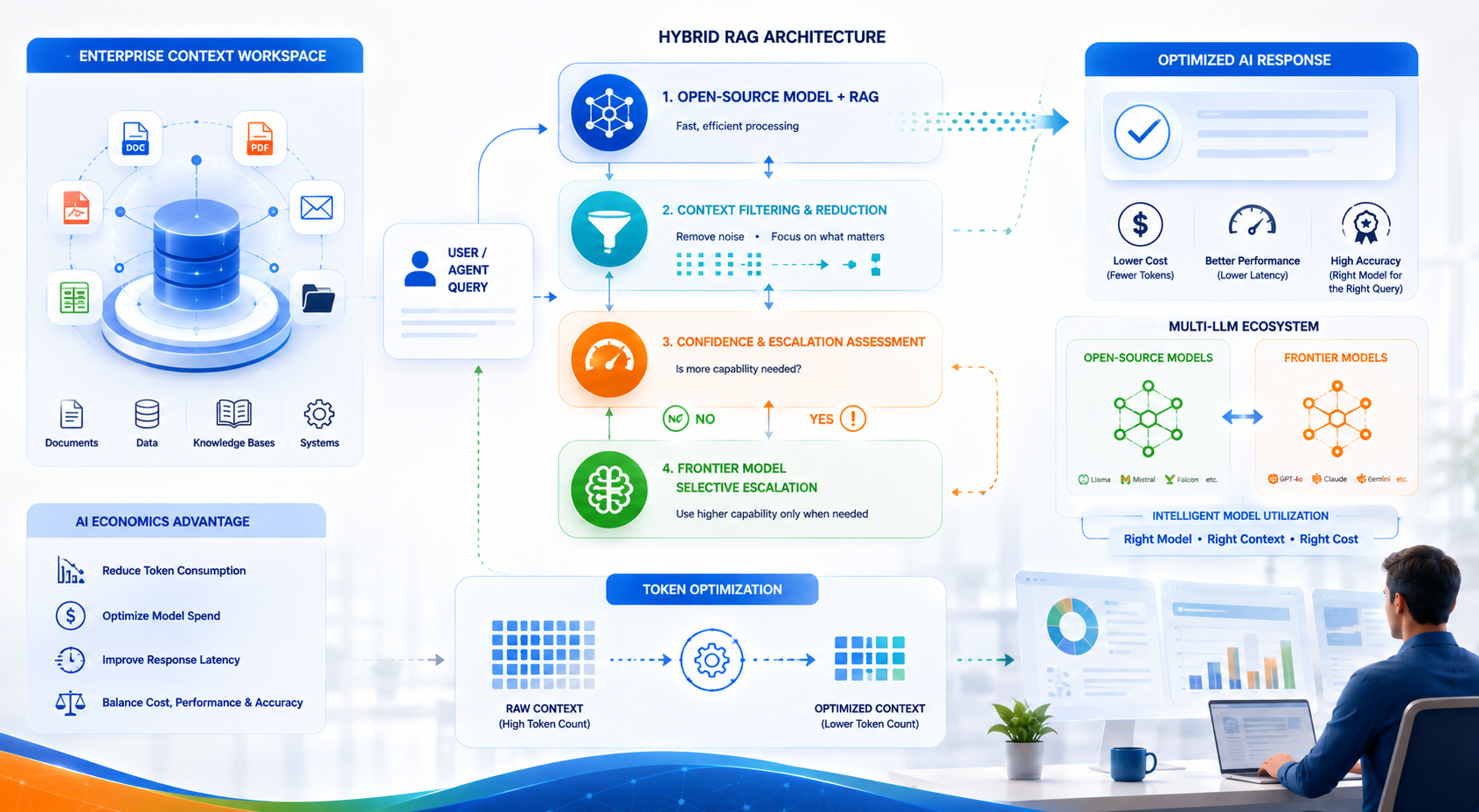
Designed a Hybrid RAG architecture that intelligently combines open-source and frontier models to balance response quality, performance, and AI economics.
The solution uses an open-source model and RAG pipeline as the initial processing layer. Relevant information is retrieved, evaluated, and distilled to establish preliminary context while reducing unnecessary information before invoking more expensive model resources.
Requests that can be satisfactorily addressed within this layer remain with the open-source environment. When additional reasoning, knowledge, or response quality is required, the solution selectively escalates the request to a frontier model, passing a more focused and contextually relevant payload rather than the complete underlying information set.
This creates an intelligent model-utilization strategy in which frontier AI becomes a selectively consumed resource rather than the default destination for every request.
Solution Architecture
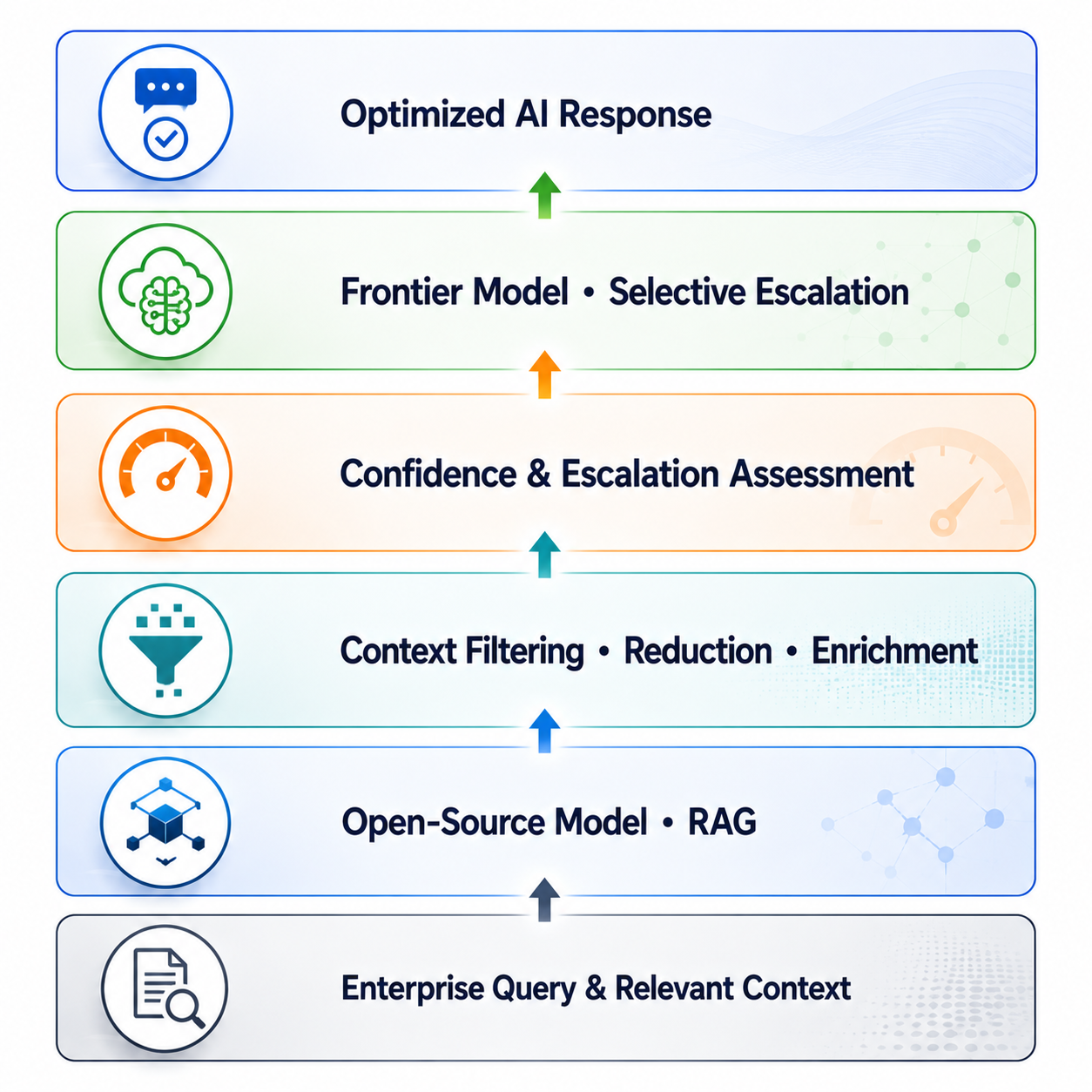
The architecture deliberately separates retrieval and preliminary processing from frontier-model escalation, enabling model utilization to become a configurable decision within the AI workflow.
Business Outcomes
- Reduced AI operating costs by limiting unnecessary frontier-model consumption
- Lower token utilization through targeted retrieval and context reduction
- Improved response efficiency by handling appropriate requests with open-source models
- Preserved response quality by escalating complex requests when higher-capability models are warranted
- Greater control over AI economics through configurable model selection and escalation policies
- Reduced dependency on a single model provider through a hybrid architecture
- Improved cost/performance/accuracy balance as enterprise AI adoption scales
The broader outcome is a shift from simply consuming AI models to actively managing AI inference as an enterprise resource.
Technologies
Hybrid AI
- Open-Source LLMs
- Frontier Models
- Hybrid Model Architecture
- Model Routing & Selective Escalation
- Confidence Assessment
RAG & Context Optimization
- Retrieval Augmented Generation (RAG)
- Semantic Retrieval
- Vector Databases
- Embedding Models
- Context Filtering & Reduction
- Prompt and Context Engineering
Platform & Operations
- Cloud-Native Architecture
- APIs & Model Integration
- AI Agents
- Token Consumption Monitoring
- AI Observability
- Usage & Cost Analytics
How Reasoned Insights Applies This Experience Today
Reasoned Insights helps enterprises design AI architectures that treat model intelligence, token consumption, performance, and cost as interconnected design decisions.
Rather than defaulting every interaction to the most capable and typically most expensive model, we apply Hybrid RAG architectures that combine open-source models, contextual retrieval, intelligent filtering, and selective access to frontier models. The architecture can be configured around an organization’s requirements for accuracy, latency, privacy, and economics.
This approach enables organizations to progress from simply asking:
“Which AI model should we use?” toward the more strategic question,
“How do we intelligently use the right model, with the right context, for the right request?”
The result is a more sustainable foundation for scaling enterprise AI – balancing cost, performance, and accuracy while preserving access to frontier intelligence where it creates the greatest value.