
Industry
Cross-Industry | Knowledge Intensive Enterprises | Professional Services | Financial Services | Technology | Industrial Enterprises
Business Challenge
Enterprise AI can retrieve information and generate increasingly sophisticated responses, but knowing what an organization values, prefers, and considers successful requires more than access to enterprise data.
Organizations accumulate institutional knowledge not only in documents and systems, but also through the decisions, judgment, preferences, and experiences of their people. Two technically valid AI responses may have very different value depending on organizational priorities, business practices, risk tolerance, operating context, and desired outcomes.
The challenge is to create AI systems that do more than access enterprise knowledge, systems that can learn from enterprise specific feedback and progressively adapt to what matters to the organization.
Solution Approach
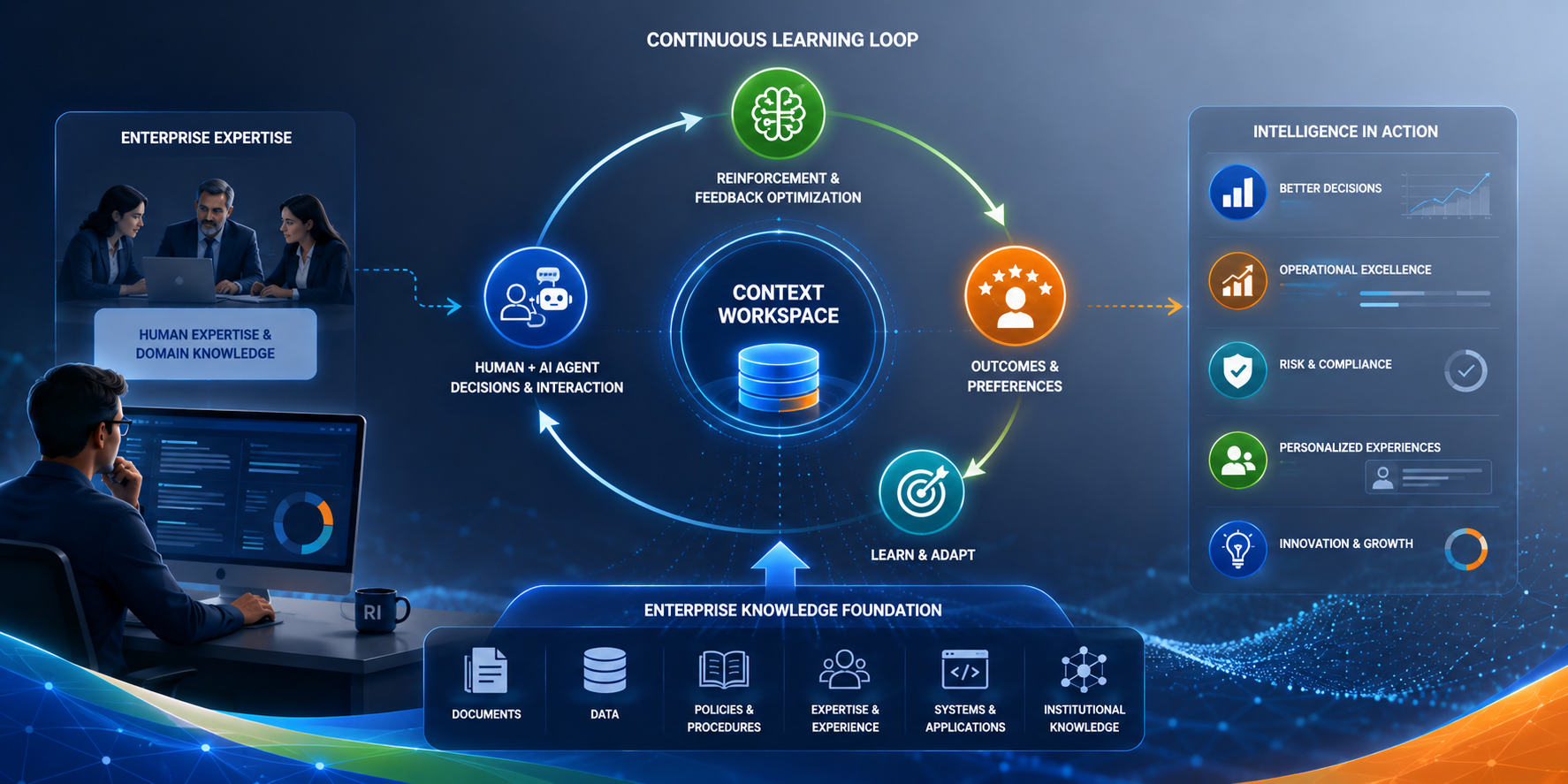
Designed a feedback driven AI architecture that combines enterprise context with human expertise, preference signals, and business outcomes to create a continuous learning loop.
RAG provides the contextual foundation by grounding AI interactions in relevant enterprise information and institutional knowledge. Human experts then evaluate AI-generated recommendations and outcomes through explicit feedback, preference selection, corrections, approvals, and other enterprise defined signals.
These signals are captured and transformed into learning inputs that can be used to optimize model behavior, Agent decision-making, retrieval strategies, prompts, policies, and workflows. Reinforcement learning and related feedback driven optimization techniques provide mechanisms for progressively aligning AI behavior with enterprise priorities.
The resulting system evolves from simply understanding organizational information toward learning how the enterprise applies that information to make decisions.
Solution Architecture
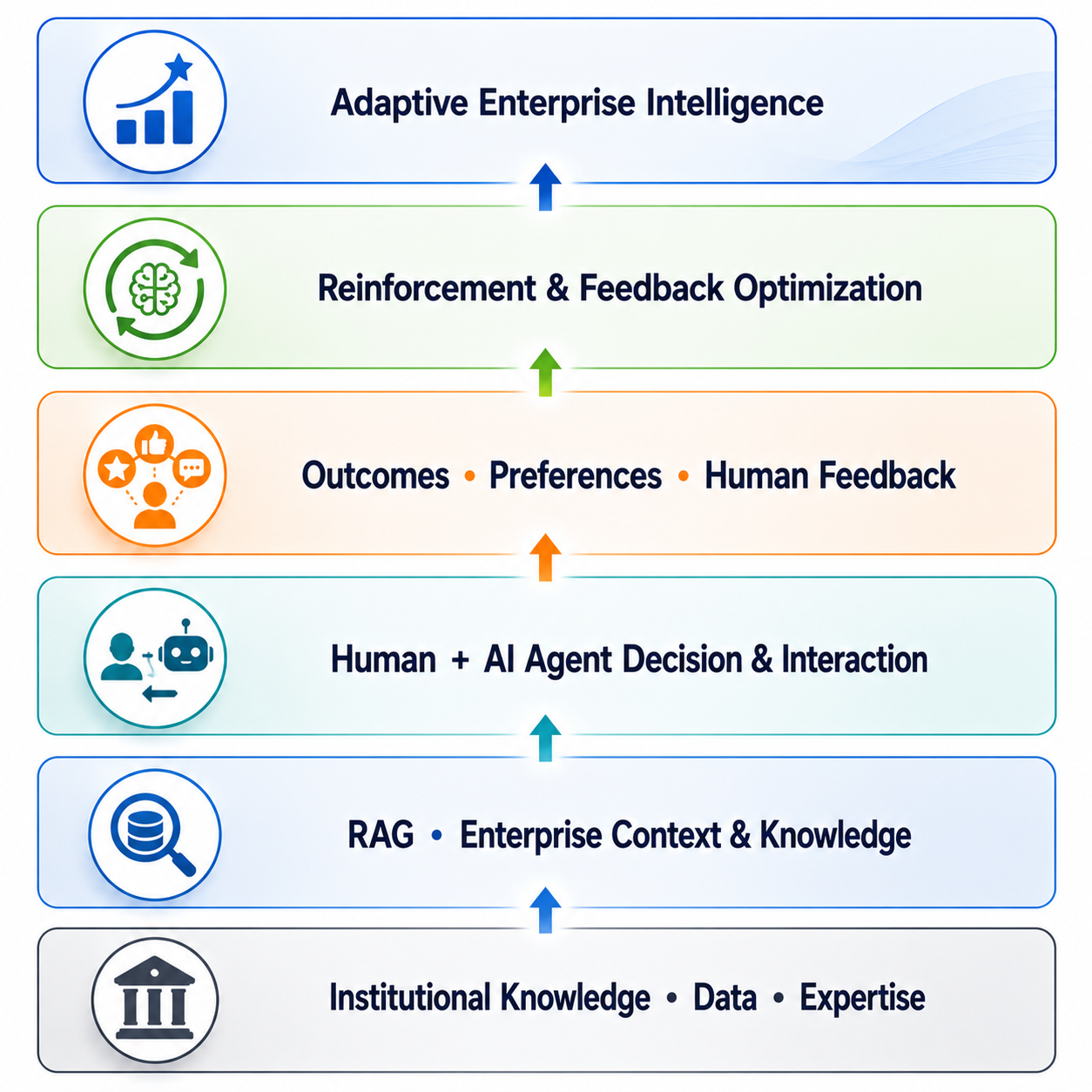
Unlike a conventional linear AI pipeline, the architecture creates a continuous feedback loop in which enterprise interactions and outcomes inform subsequent AI behavior.
Business Outcomes
- Aligns AI behavior with enterprise priorities rather than relying solely on generic model behavior.
- Incorporates human expertise directly into AI optimization and decision processes.
- Learns from preferences and outcomes to make future interactions increasingly relevant to the organization.
- Captures institutional knowledge that traditionally resides within human experience and organizational practices.
- Preserves organizational context as AI becomes embedded across business workflows.
- Improves consistency by translating expert judgment and preferred practices into reusable learning signals.
- Creates continuous improvement as human and operational feedback accumulates.
- Establishes a foundation for adaptive enterprise intelligence that evolves alongside the organization.
The strategic outcome is an AI capability that progresses from knowing what the enterprise knows to learning what the enterprise values.
Technologies
Learning & Optimization
- Reinforcement Learning
- Reinforcement Learning from Human Feedback (RLHF)
- Preference Optimization
- Feedback-Driven Optimization
- Reward / Evaluation Models
- Human-in-the-Loop AI
Enterprise AI
- AI Agents
- Large Language Models
- Retrieval Augmented Generation (RAG)
- Context Engineering
- Enterprise Knowledge Grounding
Feedback & Intelligence
- Human Feedback Capture
- Preference & Outcome Signals
- Evaluation Frameworks
- Agent and Model Observability
- Enterprise Context Management
- Continuous Evaluation
How Reasoned Insights Applies This Experience Today
Reasoned Insights helps organizations progress beyond AI systems that simply retrieve enterprise information toward systems that can adapt to enterprise-specific priorities, expertise, preferences, and outcomes.
We combine RAG and context engineering with human-in-the-loop workflows and feedback driven optimization to create an enterprise learning layer. Human expertise remains central: decisions, corrections, preferences, approvals, and observed outcomes become signals that can progressively improve how AI Agents reason, recommend, and operate within the organization.
The objective is not to teach an AI system everything about an enterprise upfront. It is to establish the mechanisms through which the system can continuously learn what matters to that enterprise.