
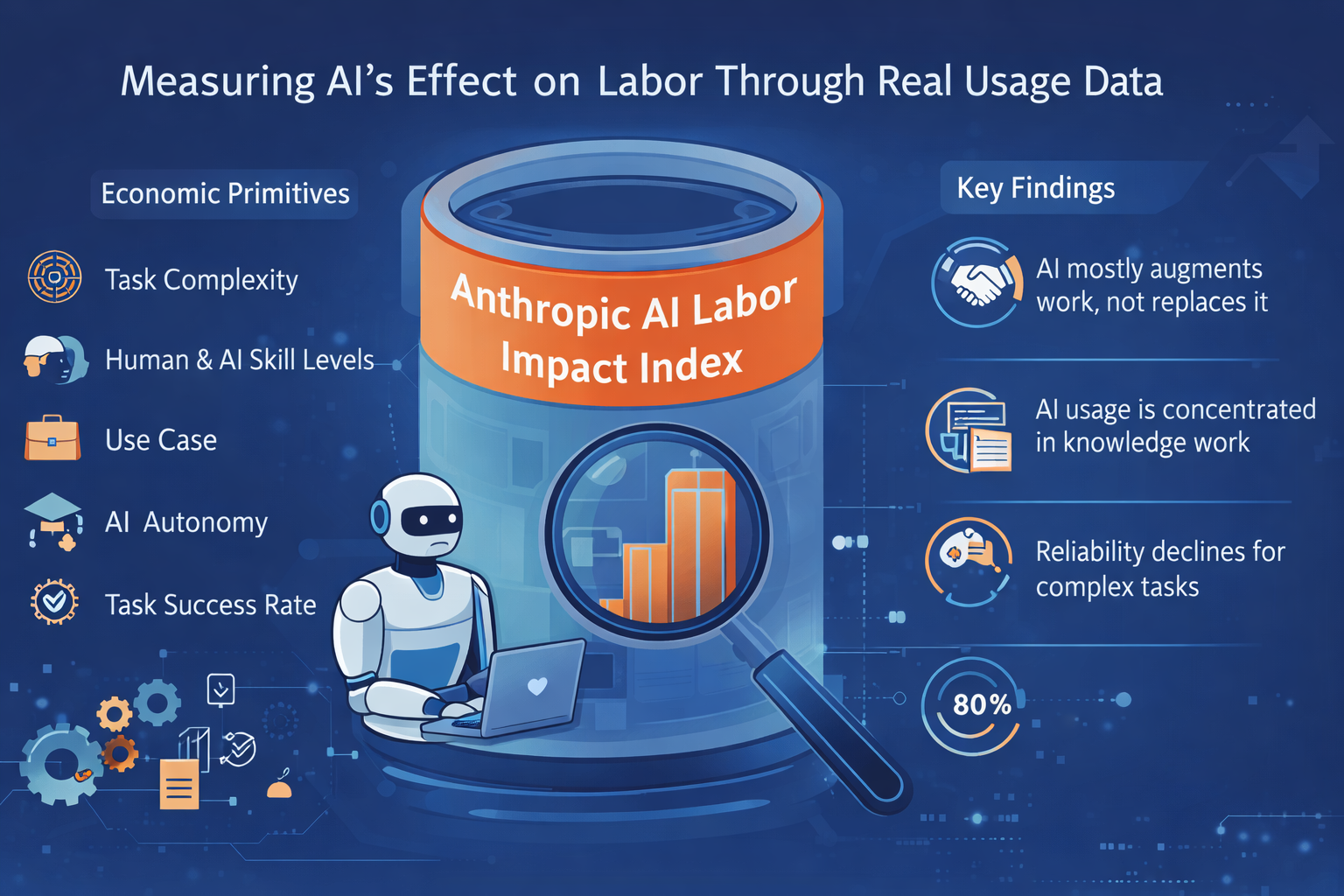
Artificial intelligence is often discussed in terms of its potential impact on jobs and productivity. But much of that discussion relies on speculation rather than empirical evidence. To address this gap, Anthropic, the company behind the Claude family of AI models introduced the Anthropic Economic Index, sometimes referred to as an AI labor impact index, designed to measure how AI systems are actually being used across the economy.
Rather than predicting the future of work, the index attempts to observe AI usage in real time, analyzing how people interact with Claude across consumer and enterprise environments. By examining millions of anonymized interactions, the index provides one of the first data-driven attempts to understand how generative AI is affecting tasks, productivity, and the division of labor between humans and machines.
The result is a framework that moves the AI discussion from hype and speculation to measurable patterns of adoption and productivity.
Understanding the Methodology
Most labor-market analyses rely on surveys or employer reporting. Anthropic’s approach is different: it analyzes actual usage data from Claude, collected through a privacy-preserving process. The January 2026 report examined roughly two million real interactions, about half from Claude’s consumer interface and half from enterprise API usage.
These interactions are then mapped to more than 3,000 distinct work tasks, allowing researchers to determine:
- Which tasks users delegate to AI
- Whether AI is augmenting or automating work
- How complex the tasks are
- Whether the AI successfully completes them
This methodology allows the index to measure how AI is used in practice, rather than how it could theoretically be used.
Early results suggest that AI usage is concentrated in specific categories, particularly software development, writing, analysis, and customer support tasks, but that most usage today still represents augmentation rather than full automation.
In other words, people are using AI primarily as a productivity tool rather than a replacement for human labor.
The Five Economic Primitives
The January 2026 update significantly expanded the framework by introducing five new measurement dimensions called “economic primitives.” These primitives represent the fundamental characteristics of human-AI interactions and allow the index to quantify AI’s economic impact more precisely.
1. Task Complexity
Task complexity measures how difficult or time-consuming a task would be for a human without AI assistance.
For example:
- Writing a short summary might be considered low complexity
- Designing an analytical research plan would be high complexity
The index measures complexity partly by estimating how long a competent professional would need to complete the task independently.
One of the key findings is that AI performs reliably on simpler tasks but struggles more with complex tasks, where reasoning, judgment, or domain expertise becomes critical.
2. Human and AI Skill Levels
This primitive measures the skill level required from both the human user and the AI system to complete a task.
For example:
- Low-skill tasks might include answering simple product questions.
- High-skill tasks might involve programming, research analysis, or strategic planning.
Interestingly, the report suggests that AI adoption is strongest among higher-skill workers, who use AI to accelerate complex workflows rather than replace them.
This finding challenges the common narrative that AI primarily replaces low-skill work.
3. Use Case: Work, Education, or Personal
The third primitive categorizes interactions based on why users are engaging with AI.
The report identifies three primary categories:
- Work tasks (professional or enterprise workflows)
- Educational use (learning, studying, or coursework)
- Personal use (general curiosity, personal projects, daily life tasks)
By distinguishing between these contexts, researchers can analyze how AI adoption varies across sectors and regions.
For example, some countries show higher use of AI for education, while enterprise adoption dominates in developed economies.
4. AI Autonomy
AI autonomy measures the degree of decision-making responsibility delegated to the AI system.
This dimension differs from simple automation.
For example:
- A translation request may be automated but requires little decision making.
- A request to analyze a dataset and recommend a strategy requires higher autonomy.
The index distinguishes between:
- Directive interactions where the human tightly controls the task
- Autonomous tasks where the AI determines the process
Tracking autonomy helps researchers understand how quickly AI systems are moving toward agent-like behavior.
5. Task Success Rate
The final primitive evaluates how successfully the AI completes the requested task.
Success is measured through a combination of:
- user feedback
- output quality analysis
- contextual evaluation of task completion
One important observation is that success rates decline as task complexity increases.
This highlights a critical limitation of current generative AI systems: while they excel at routine knowledge work, they still struggle with multi-step reasoning and high-stakes decision making.
What the Index Reveals About AI and Work
Using these primitives, the index produces several insights about the current state of AI adoption:
- AI is primarily augmenting work, not replacing it.
Most interactions involve collaboration between humans and AI rather than full automation. - AI usage is concentrated in knowledge work.
Software engineering, writing, analysis, and research dominate AI interactions. - High-skill workers benefit the most.
AI often amplifies human expertise rather than replacing it. - AI reliability declines for complex tasks.
The technology performs best when tasks are well-defined and structured.
These findings paint a more nuanced picture than the popular “AI will replace all jobs” narrative.
Strengths of the AI Labor Impact Index
The index has several important advantages.
1. Real World Data
Unlike survey based studies, the index analyzes actual AI interactions, providing a much more accurate view of how AI is used in practice.
This makes it one of the most empirical approaches currently available for studying AI’s economic impact.
2. Granular Task Level Analysis
By mapping interactions to thousands of tasks, the index allows researchers to understand how AI affects specific job activities, not just occupations.
This is important because most jobs consist of multiple tasks, some of which can be automated while others cannot.
3. Forward Looking Indicators
Because the index tracks AI usage continuously, it can serve as an early signal of economic disruption.
Changes in task automation patterns could indicate future shifts in labor demand.
Limitations and Critiques
Despite its innovation, the index also has several limitations.
1. Platform Bias
The dataset only reflects interactions with Claude, meaning it may not capture usage patterns from other major AI systems.
Different models may be used for different tasks, potentially skewing results.
2. Selection Bias
The users who interact with Claude may not represent the entire workforce.
For example:
- AI-literate professionals may be overrepresented
- Certain industries may adopt AI faster than others
This can distort the perceived economic impact.
3. Measurement Challenges
Metrics such as task success and complexity are inherently subjective.
Estimating how long a task would take a human without AI introduces assumptions that may affect the results.
4. Rapid Technological Change
AI capabilities evolve quickly.
An index based on current usage may underestimate how quickly automation could expand as models improve.
Final Thoughts
The Anthropic AI Labor Impact Index represents one of the first serious attempts to quantify the real economic effects of generative AI.
By analyzing millions of real interactions and introducing structured metrics such as task complexity, autonomy, and success rate, the framework provides a powerful lens for understanding how humans and AI collaborate.
At the same time, it is important to treat the index as an early measurement tool rather than a definitive forecast. AI technology is evolving rapidly, and labor markets adapt in unpredictable ways.
Still, initiatives like this move the conversation about AI and jobs from speculation toward evidence-based analysis—a critical step as organizations, policymakers, and workers prepare for a future where AI increasingly participates in the workforce.