
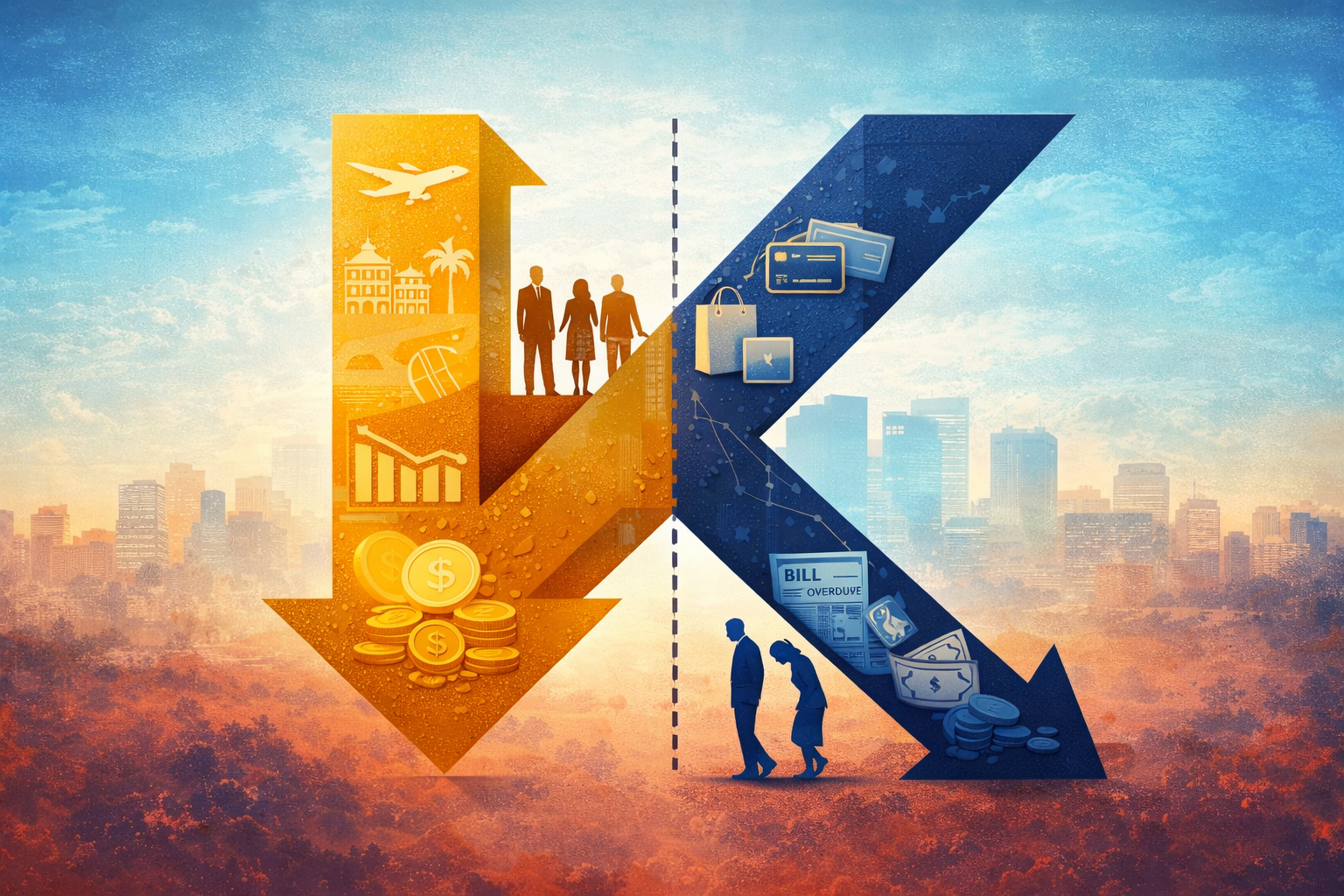
Over the past few years, economists and business analysts have increasingly used the term “K-shaped economy” to describe the uneven recovery and growth patterns following major economic disruptions. In a K-shaped economy, different segments of society move in opposite directions: one group prospers and climbs upward, while another struggles and falls behind. The shape of the letter K captures this divergence.
What is becoming increasingly clear, however, is that the modern K economy is no longer just an economic pattern, it is becoming a business strategy. Many companies have discovered that focusing on consumers at the upper end of the income distribution, the “upper K”, is more profitable and predictable than trying to serve the broader market. As a result, businesses are designing products, services, and pricing models that increasingly cater to affluent consumers while quietly deprioritizing those in the lower half of the economic spectrum.
This shift is creating what might be called the tyranny of the upper K economy: a system where companies increasingly optimize for the wealthiest consumers while everyone else faces reduced options, higher prices, or diminished service.
The Rise of the Upper K Strategy
The past decade has demonstrated that certain sectors perform exceptionally well when targeting affluent customers. Companies that serve high-income consumers—especially in premium consumer discretionary categories—have experienced robust growth even during periods of economic uncertainty.
Examples include:
- Premium airlines offering business-class upgrades and luxury travel experiences
- High end credit card companies providing exclusive perks and concierge services
- Luxury consumer brands that command high margins
- Premium subscription services across travel, entertainment, and hospitality
These companies have discovered something powerful: wealthier consumers are far less sensitive to price increases.
When inflation rises or economic conditions tighten, affluent consumers often continue spending on travel, dining, luxury goods, and premium services. Meanwhile, middle and lower income consumers cut back dramatically.
For businesses trying to maintain revenue growth and shareholder returns, the conclusion becomes obvious: focus on the customers who keep spending regardless of the economic climate.
Why Companies Prefer the Upper K
From a purely financial perspective, targeting the upper K makes compelling sense.
Higher Margins
Premium products and services generate significantly higher margins.
A luxury airline seat, premium credit card, or exclusive hotel experience can produce two to five times the profit of a mass market alternative.
Companies therefore increasingly design their offerings to maximize profitability per customer rather than the total number of customers served.
More Stable Demand
High income consumers exhibit more stable spending patterns.
Even during economic slowdowns, affluent households tend to maintain spending on travel, experiences, and luxury goods. This makes them more predictable customers, reducing volatility in revenue streams.
For companies managing investor expectations and quarterly earnings, this predictability is highly valuable.
Brand Prestige and Market Positioning
Targeting affluent customers also enhances brand perception.
A brand associated with premium experiences, exclusivity, and high status often commands stronger customer loyalty and pricing power.
Once companies move into the premium category, they become reluctant to move back down-market, even if that means abandoning large segments of potential customers.
The Quiet Deprioritization of the Lower K
The downside of this shift is that lower income consumers increasingly find themselves excluded from products and services that were once accessible.
In many industries, companies have quietly deemphasized offerings designed for price-sensitive customers.
Instead of maintaining a balanced portfolio of products across income segments, businesses increasingly optimize for high margin premium offerings.
This shift manifests in several ways.
Airlines: The Premium Cabin Revolution
Airlines provide one of the clearest examples of the upper K strategy.
Historically, airlines relied heavily on economy class passengers for revenue. Today, however, airlines increasingly prioritize premium cabins and loyalty programs targeting high income travelers.
Premium seating categories such as business class, premium economy, and luxury upgrades now represent a significant share of airline profits.
At the same time:
- Economy seats are becoming more constrained
- Additional fees are added for basic services
- Comfort and convenience for budget travelers are reduced
Airlines have effectively turned economy passengers into price sensitive volume customers, while the real profit comes from the premium segment.
Credit Cards: The Rise of Elite Financial Products
The credit card industry provides another striking example.
Premium cards now offer:
- Airport lounge access
- Luxury travel perks
- Concierge services
- Exclusive dining experiences
These products often carry annual fees exceeding thousand dollars, yet they continue to grow rapidly.
Meanwhile, lower income consumers face:
- Higher interest rates
- Reduced rewards
- Fewer benefits
Financial institutions increasingly view affluent cardholders as their most valuable customers, focusing on maximizing spending and loyalty within that group.
Hospitality and Travel: The Experience Economy
Hotels, resorts, and travel companies have also embraced the upper K strategy.
Many hospitality brands now emphasize luxury experiences and high-end travel packages, including:
- Private villa accommodations
- Exclusive resort memberships
- VIP concierge services
These offerings cater to affluent travelers willing to spend thousands of dollars for premium experiences.
Budget travelers, by contrast, encounter fewer options and rising prices even in traditionally affordable segments.
Consumer Goods: Premiumization Everywhere
The shift toward the upper K is also visible in everyday consumer products.
Companies across industries have embraced “premiumization”, offering higher-end versions of products at significantly higher prices.
Examples include:
- Luxury athletic wear
- Premium cosmetics and skincare
- High-end consumer electronics
- Designer collaborations in retail
While these products generate strong margins, they also signal a broader trend: companies increasingly prioritize value extraction from affluent consumers rather than affordability for the mass market.
The Consumer Impact
For consumers in the lower half of the K economy, the consequences are significant.
Reduced Access
Products and services once designed for mass markets may become unaffordable or unavailable.
Increased Fees
Basic services increasingly include add-on fees, disproportionately affecting price sensitive consumers.
Limited Product Innovation
Companies invest heavily in premium experiences while devoting fewer resources to improving lower-cost alternatives.
Why Companies Continue the Shift
Despite these consequences, businesses have powerful incentives to continue focusing on the upper K.
The primary reason is simple: capital markets reward profitability over inclusivity.
Public companies are under constant pressure to:
- Increase margins
- Demonstrate pricing power
- Deliver predictable revenue growth
Serving affluent consumers aligns perfectly with these goals.
The Risk of Over-Premiumization
However, there are potential long-term risks to the upper K strategy.
If companies focus too heavily on affluent consumers, they may neglect the broader market that historically supported their growth.
Over time, this could create:
- Greater economic inequality
- Reduced brand loyalty among middle-income consumers
- Market fragmentation
In extreme cases, entire industries could become bifurcated, with luxury services thriving while basic services deteriorate.
The Future of the K Economy
The K economy is unlikely to disappear anytime soon. Income inequality, demographic shifts, and global wealth concentration all reinforce the dynamics that favor premium consumers.
For companies, the temptation to focus on the upper K will remain strong.
But businesses also face an important strategic question:
How far can they push the premium model before the broader consumer base becomes economically irrelevant, or socially unstable?
A healthy market historically depends on a vibrant middle class. If companies systematically abandon that segment, the long-term consequences could extend beyond business strategy into the structure of the economy itself.
Final Thoughts
The K economy has become one of the defining economic patterns of our time. But what began as a description of economic divergence is rapidly becoming a blueprint for corporate strategy.
Companies have discovered that the fastest path to growth often lies at the top of the income distribution. The result is a marketplace increasingly designed for the affluent.
For businesses, the upper K offers profit, stability, and brand prestige.
For many consumers, however, it represents a growing sense that the economy is moving upward, just not for them.
And that is the quiet tyranny of the upper K economy.