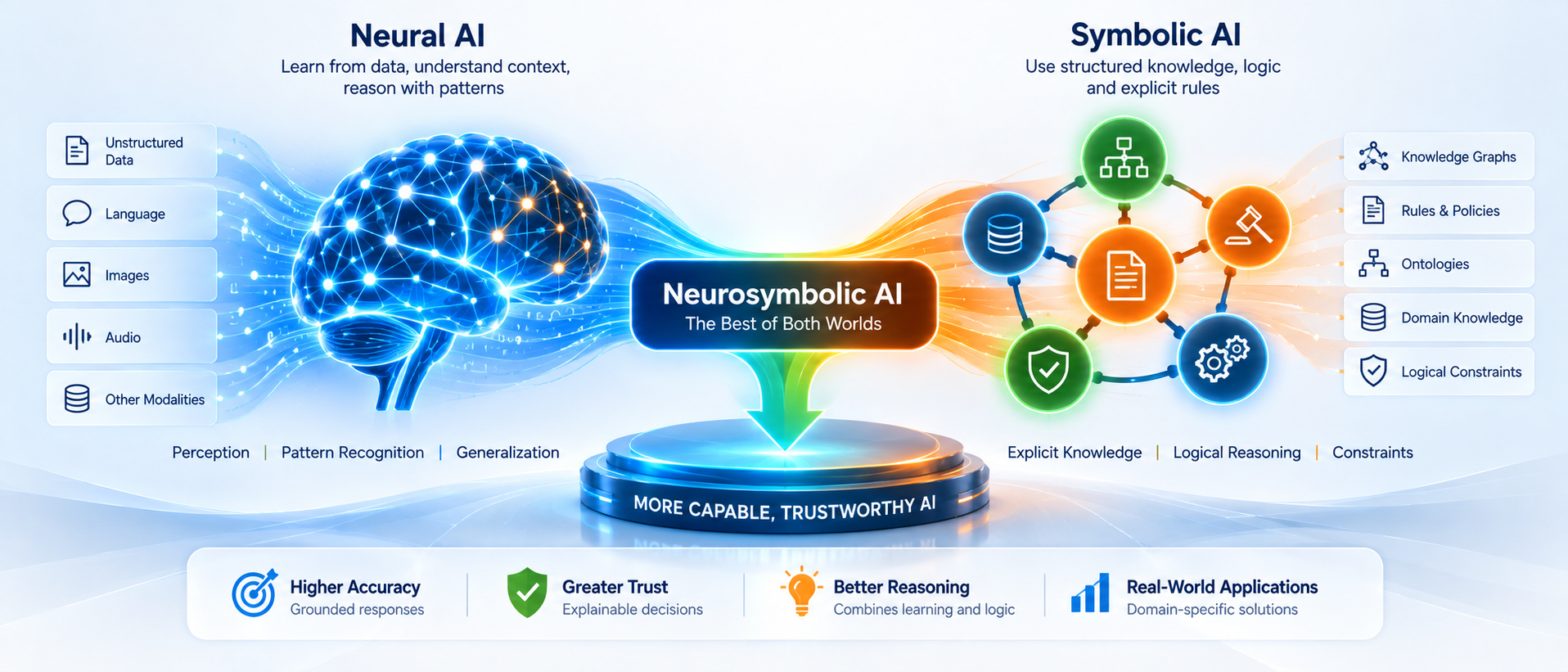
Artificial Intelligence has two rather different approaches to solving problems. Neural AI, powered by artificial neural networks, learns patterns from enormous amounts of data. This is the technology behind Large Language Models (LLMs), image recognition, and generative AI. It is remarkably good at recognizing patterns, understanding language, and generating creative responses.
Symbolic AI, on the other hand, relies on explicitly defined facts, rules, logic, and relationships. Think of Neural AI as an imaginative student who has read millions of books, while Symbolic AI is the meticulous mathematics teacher who insists that every answer follow the rules. One is flexible and creative; the other is structured and predictable.
Neurosymbolic AI brings these two approaches together. Instead of asking neural networks to handle everything, it combines their ability to learn and interpret information with symbolic systems capable of applying explicit rules and logical reasoning. Imagine an AI assistant helping prepare your taxes. The neural component understands your questions and interprets financial documents, while the symbolic component applies tax rules and performs calculations. The objective is to combine the adaptability of neural networks with the precision and discipline of symbolic reasoning.
Why Does This Matter?
Anyone who has used an LLM has probably encountered an answer that sounds authoritative but turns out to be spectacularly wrong. These errors, commonly called hallucinations, occur because LLMs generate responses based on learned patterns rather than inherently verifying every statement against established facts or rules. They can write beautiful explanations of mathematical problems while occasionally getting the arithmetic wrong. It’s rather like hiring a brilliant consultant who never admits when they don’t know something!
Neurosymbolic AI offers a promising way to address this limitation. By introducing explicit knowledge, constraints, and reasoning mechanisms, AI systems can check whether proposed answers satisfy known rules. A financial AI Agent, for example, might interpret an invoice using an LLM but rely on a rules engine to verify spending limits, approval authority, and compliance requirements before authorizing payment. The neural network proposes; the symbolic system verifies. Neither is infallible, but together they can provide stronger safeguards.
The Benefits Go Beyond Accuracy
The potential advantages include greater reliability, explainability, consistency, and control. Symbolic reasoning can make certain decisions easier to trace because the rules and relationships are explicit. It can also help organizations incorporate business policies, regulatory requirements, and domain expertise without expecting an LLM to memorize everything. For autonomous AI Agents, this distinction becomes particularly important. An agent that merely recommends an incorrect action is inconvenient; an agent that executes it can become expensive!
Where Does the Research Stand?
Neurosymbolic AI is not a new idea, but advances in LLMs have renewed interest in it. Researchers are exploring combinations of language models, knowledge graphs, logical reasoning engines, theorem provers, and constraint solvers. Significant challenges remain, including translating ambiguous language into reliable symbolic representations, maintaining knowledge, and integrating these components efficiently.
The future may not belong exclusively to bigger neural networks or increasingly elaborate rulebooks. It may belong to systems that know when to be creative, when to follow the rules, and when to check their own homework.